Monday, 2 July 2012

Wildlife Weekender

Another weekend, another new bird, and another lovely morning exploring some local wildlife with the kids.

The tick was an Alpine Swift on Sunday 1st July, at Buckton Cliffs, East Yorkshire (although it felt like Cleveland by the time I’d walked there along the cliffs from Bempton). I’d earned enough brownie points to have the late afternoon free for some birding, so decided a trip to the sunny east coast was the best bet – especially if there was a new bird in it for me.

I parked at Bempton RSPB, and after walking almost all the way the Filey, I arrived at the trig point where most people had been viewing the bird. There were no other birders present when I arrived at 18:30, so I set about finding it among the thousands of similar sized and similar coloured birds whizzing around in front of me. The large numbers of Gannet, Kittiwake, Fulmar, Herring Gull, and Rock Dove didn’t hinder the search too much, but the clouds of brown/black and white Guillemot, Razorbill and Puffin did.

After about ten minutes I picked it out, being the only small black/white bird breaking the horizon (very occasionally), although it was the Swift shape that first made it stand out. I stayed and watched for an hour as it came in and out of view, most of the time with barely a flicker of its wings. The sickle shape of the bird was striking; the wings were so long and swept back. The tail was long and forked. On closer inspection the upperparts were a dark brown, not black; but this contrasted well with the clean white breast.

I watched through my bins as it swooped dizzyingly from high up, silhouetted against the clouds, to down towards the cliff face below me against a background of surf and rocks. Because of this movement, scope views weren’t easy and photos (with my old compact camera) were nigh on impossible.

I was a lovely evening to be sat on a cliff staring out into the North Sea – warm, sunny, with a mild breeze and few clouds. Very quiet – I suspect many people were at home watching the Euro 2012 final.

Filey Bay from Buckton Cliffs, East Yorkshire - Sunday 1st July 2012

On the way back to the car I got some great views of Corn Bunting, some of which I’d heard singing while watching the Alpine Swift. I managed a photo through my scope before this one flew off, but it really doesn’t do justice to the views I was getting.

Corn Bunting, Buckton Cliffs, East Yorkshire - Sunday 1st July 2012

On the way back I attempted to listen to the football on the radio, but the MW reception is pretty poor in the Wolds. So, the obvious choices were The Queen is Dead by The Smiths and Black Sabbath's Sabbath Bloody Sabbath. Obviously. And I got a lovely bonus of a Barn Owl floating around over the road and right over the car at Wetwang.

Before my rabid inner twitcher took over, I’d had a great weekend experiencing nature with the family. On Saturday 30th June I took my kids around Rodley Nature Reserve. Regular readers will know this is my patch (or one of them) and I am often singing its praises. “Proper” birding isn’t easy with kids, but if you want to educate and inspire children with a range of wildlife without going far from home, you should bring them to a place like Rodley NR.

This Saturday’s visit didn’t disappoint. We watched the Common Tern family, one adult fishing while the other sat protectively with the youngster on the raft. A pair of Mute Swan made their stately way from the duck marsh to the lagoon with their eight cygnets in tow.

My favourite sight was a pair of Little Grebe displaying in front of the hide we were in. The birds faced one another and arched their wings while shaking their heads from side to side. Then, both birds sank simultaneously. After the surfaced they “ran” across the water towards each other, before settling down and repeating the whole courtship ritual again. At first I thought it might be a threat display, until I saw the level of synchronisation and, ultimately, the way the birds seemed otherwise happy in each other’s company.

We did some pond dipping, finding all kinds of stuff in our nets: half-grown frogs, water boatman, pond skaters, minnows, and so on. Over the pond were some blue damselflies (either Azure or Common Blue – not sure) and a Four-spotted Chaser. Around the pond was a scruffy young Common Whitethroat, recently fledged because it seemed to be having trouble landing on a suitable perch!

Four-spotted Chaser, Rodley NR, Leeds, West Yorkshire - Saturday 30th June 2012

Friday, 29 June 2012

Little Swift and little sleep


Little Swift, New Brighton, Merseyside - Saturday 23rd June 2012

I did some birding last weekend: two very different types of birding.

On Saturday I was mostly a rabid twitcher, hauling myself out of bed at 02:15 (only 90 minutes after getting into bed) and driving to Merseyside simply for the pleasure of seeing a new bird.

On Sunday I was a duck-counting, data-collecting, patch worker, arriving on-site at 05:45 for the monthly BTO WeBS count at Rodley Nature Reserve.

The new bird was Little Swift (Apus affinis), a bird of Mediterranean Africa and the Middle East, and of Sub-Saharan Africa and India. It was first reported on Friday 22nd, showing very well over the promenade at New Brighton, on the Wirral. An quick-witted birder noted where it when to roost that night, and put the news out. Hoping to get there before the bird woke up, I arrived around 04:15 and was soon told it was still roosting in the same spot – on a window ledge on the second floor of Pier House.

The Little Swift on my camera screen - it's asleep on the 2nd-floor window ledge, above the Pier House front door.

Through my scope I could see the bird breathing and occasionally shuffling on the ledge. The bird looked small compared to a Common Swift, one of which was roosting at the other end of the building. At rest, the Little Swift’s wings and tail did not protrude as much. The main difference was the obvious large pale rump, which was bigger than on a House Martin, and extended round to the flanks. There was also clear pale edging to the flight feathers. The pale fringes were likely due to the bird’s age, making it a juvenile or even a first winter, thus raising questions about its origin – could it have been born south of the equator? Well, I have no idea.

At 05:15 the bird lifted its head up briefly to show its pale, almost frosty face. Unfortunately, I didn’t get the face on film (it was so brief, and my camera didn’t have the battery life to run continually for the 1.45 hours I watched it on the ledge). But, the movement of the bird as it breathes it clear in the video.


The Little Swift eventually left its ledge at 05:55, much later than the Common Swifts, which had been feeding overhead for a good 30 minutes by then. The bird joined its cousins and gradually the flock moved out over the Mersey to feed. The Little Swift had a slightly different flight style to the Commons, with more mid-air stops (the tail could be seen to fan out at the bird applied the brakes) and upward lurches. The short tail helped you to pick the bird out too, and the white rump was easy to see from the side as well as the back/top.

One bizarre incident at the twitch was a bloke emerging from the beach with an adult Great Crested Grebe under his arm, asking all the birders if anyone wanted to take it of his hands. He’d driven passed earlier, at about 05:30, asking in a comedy gruff voice, “What yer lookin’ at?”, and then took his three or four dogs for a walk on the beach. Not sure if his dogs had attacked the grebe in the first place, but he was concerned they might eat it. He seemed (understandably) confused that none of the birders (nature lovers, surely?!) wouldn’t take the bird; perhaps not understanding that most of them were likely to be long-distance twitchers who didn’t want an injured grebe in their car for 2-3 hours as they drove home.

It was good to meet up with Secret Twitcher, another early riser from West Yorkshire, and be able to admit our twitching urges without fear of ridicule. Hopefully we’ll arrange shared travel on some future twitches, and save some money.

By way of mitigation for the fuel costs and general grubbiness of twitching, I was out bright and early on Sunday around Rodley, doing the monthly WeBS count and all-bird survey. Always a pleasure to tour this place at dawn, or thereabouts, although we were very late this month by our standards, starting at 06:00.

Highlights were large numbers of warblers around (Willow and Sedge Warbler, Whitethroat, Blackcap, Chiffchaff, all in good numbers, but no Reed Warblers…), the breeding Common Terns, and my first Little Owl of the year.

Northern Marsh-orchid (Dactylorhiza purpurella), Rodley NR, Leeds - Sunday 24th June 2012

But, there weren’t many waterbird chicks around, which is sad but understandable after the bad weather we’ve had, and we didn’t see any Blue Tit, Chaffinch, or Willow Tit (a reserve speciality).

Suffice to say, I was very tired at work on Monday (having expended the last of my energy shouting at the TV on Sunday as England were knocked out of Euro2012). But, by Tuesday I was awake enough to make the trip to see the Pacific Golden Plover (Pluvialis fulva) at Cley.

A lovely, smart bird, feeding around an island on the North Scrape from the Swarovki Optik hide (in poor light, by the time I got there). Smaller and more delicate than a European Golden Plover, certianly "leggier", and with an apparent stumpy rear end (the tertials extend further down the primaries, giving the impression of a shorter winged and shorter tailed bird). Even from a distance it looked very striking: velvety black face and breast with a thick white border to the uppers, quite Grey Plover-esque.

Because of the poor light, and the fact I left my digiscope adapter in the car, I couldn't get any good photos. But here's a record shot.

Pacific Golden Plover, Cley Marshes NWT, Norfolk - Tuesday 26th June 2012 

Some beautiful Black-tailed Godwits too, and an immaculate Spotted Redshank in full slate-black summer plumage close up. Stunning. The obligatory Barn Owl was around too, and gave great close views as I headed back along the shingle to the car.

Afterwards I tried for some Nightjar at one of the Norfolk hotspots, without success, and spent the long journey home wondering if it was worth it. Well, I got the bird (a lifer, and a stunner at that), saw some other beauts too, and got my year list to 250. So, a hesitant yes; but if I’d dipped… Got home very late, and was falling asleep at work again the following day…

Wednesday, 13 June 2012

Honeys and High Rollers

And the odd Wobbler.

European Roller, Aldbrough, East Yorkshire - 11th June 2012
I just returned from an ace family holiday in East Anglia, which turned into a minor tick-fest. There were three new birds for Britain for me, bookending a great nature-filled holiday with the kids.

On the way down from West Yorkshire to Cambridge we called into the Welbeck Raptor Watchpoint, near Clumber Park, Nottinghamshire. I’ve heard that Honey Buzzards show here in warm weather (it was mild, but overcast, on the day we visited), but even then long waits are required between appearances. I was very lucky, then, to arrive when one was showing, high over the trees in the distance. The same one (probably) showed again a few times over the next 40 minutes.

A second bird showed better for around five minutes, slowly circling higher then moving off to the west, giving me the opportunity to really appreciate its attributes. Rather helpfully, a Common Buzzard joined it for a minute, allowing a direct comparison of structure and flight characteristics. The Honey Buzzard appeared smaller-headed, yet longer necked. It had a large, long, fanned tail, and appeared generally darker below, but with pale “armpits”. The clincher really was the soaring style – flat wings with long, slightly drooping outer primaries.

We spent the spent the first half of the week around the north Norfolk coast, based at The George at Cley. All the hours of fun and work getting my daughter into nature is paying off now she’s 7 year’s old. We went out on to the marshes on one evening and she found an impressive list of birds all by herself, many of which I had to wait years to see! Barn Owl, Little Egret, Avocet, Spoonbill, Marsh Harrier…

Rowan watching a Barn Owl at Cley Marshes

Rowan's impressive list of species at Cley from her notebook

The kids enjoyed so much we went back the next day; but this visit was cut short thanks to my 3-year-old son falling into the sea. No harm done though…

Luke watching Avocets from the East Bank at Cley

Later we went to Titchwell RSPB – a brilliant reserve for kids, families, and hardened twitchers alike. One highlight was a group of Little Gulls roosting with Black-headed Gulls on an island on the freshmarsh close to the path, allowing good comparisons. The kids enjoyed the beach, bringing back razor clam shells and the odd dead starfish, and my daughter found a recently fledged Robin on a twig right by the path – I remember the excitement of being so close to wild birds when I was kid.

I started the next day with a pre-breakfast walk around the marsh beside Cley windmill. The Barn Owl was hunting again, and among the Reed and Sedge Warblers I found a bird looking and sounding suspiciously like a Marsh Warbler. I only saw my first of these the week before, so I’m not claiming the record; but that sighting has made me grill each Acrocephalus more than I would have previously.

Seal watching at Blakeney Point, Norfolk

We went seal watching around Blakeney point, then on to Southwold, Suffolk, for a few days of extreme-weather camping, Before we finally gathered up the shattered tent poles and flailing guy-ropes three days later, we had a great time exploring the coast south of Southwold.

Walberswick Marshes, Suffolk

Drinker Moth Catepillar Philudoria potatoria - Walberwick Marshes

Rowan and I watching Stone Curlews at Minsmere RSPB, Suffolk

Luke starts his minibeast survey at Minsmere RSPB, Suffolk
 
Luke examines the bumblebee he found

Back to Norfolk for a couple of decent nights sleep in Cromer. Luckily for me someone found a Blyth’s Reed Warbler at Warham Greens on our last afternoon. Excellent. I bribed Mrs Indiebirder with some child-free time as I took the kids on the Poppy Line. This bought me 90 minutes listening and watching the BRW while the kids snoozed with mum in the car.

Anyone fancy waiting for a Blyth's Reed Warbler to show?

As I walked down to the marsh path at Warham Greens, all the birders who were leaving told me how long I’d likely have to wait for a good view – “give it a couple of hours and you might get a glimpse” was the gist of it. But, sometimes, it’s my turn to be a jammy get, and that time was today. The bird showed well soon after I arrived, and luckily I was stood where I could see it well. The views were brief but clear, long enough to see a slim bird moving along an elder branch, with grey/brown uppers (much duller than Reed Warbler and shade paler than Marsh Warbler), a three-quarters supercilium (across the lores and stopping just after the eye), and a slightly flicked-up tail. Result!

That night I was again the designated driver, so my wife could booze. All building up brownie points… I cashed them in the following day as we made our way back home. A quick(?!) two-and-a-hour diversion to see the European Roller at Aldbrough, East Yorkshire. What a corker! No point me describing this, just look at the pictures (loads of better ones on the internet, of course, by proper photographers with proper gear. These are just my lo-res digiscioped efforts with a Samsung NV15 point’n’click).


A great vacation - Norfolk never fails. All this brings my 2012 year list to an unlikely 247 (previous best: 216 in 2011), with some glaring gaps still to be filled in. My British life list is now 316. I wonder what 317 will be...

Wednesday, 30 May 2012

Blown off Course(r)

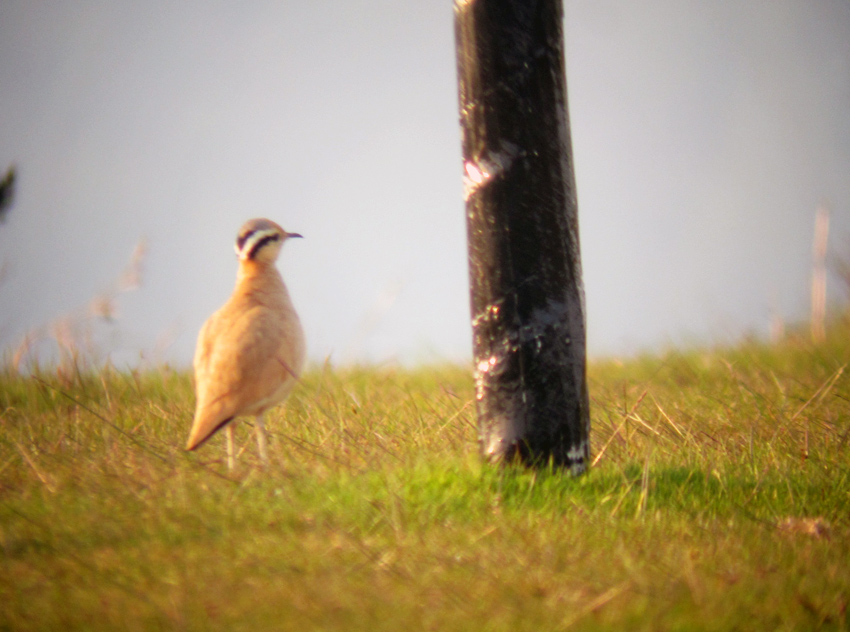
Cream-coloured Courser, Bradnor Hill, Kington, Herefordshire - 21st May 2012

I had a wonderful, long weekend of birding last week, culminating in the best twitch I’ve ever been to – the Cream-coloured Courser in Herefordshire.

The trip around Scotland had been long-planned. Led by Lee Evans, with friends from my January trip: Chris Morgan, Chris Baines, and Mike Warner (thanks for all the driving, Mike!), plus some new acquaintances: John Foster, Mike Robinson, and Paul Steventon.

I travelled up to Stirling by train on Thursday 17th May, and was met by Mike W and Paul to head straight for the Blue-winged Teal at Bridgend Farm Pool, Clyde, on a cold and cloudy evening.

Blue-winged Teal, Clyde, Scotland - 17th May 2012

The next morning we were out early getting great views of Black and Red Grouse, a beautiful male Ring Ouzel, Osprey, Dotterel, Red Kite, Short-eared Owl, while making our way to Braemar to see Ptarmigan.

Dotterel, Kirriemuir, Angus, Scotland - 18th May 2012

We continued northeast as the sun came out, seeing another new duck for me, the King Eider at Ythan Estuary, and then Greater Yellowlegs at the RSPB’s great Loch of Strathbeg reserve. I really didn't expect to Greaterlegs on my year list in consecutive years! Unfortunately, we couldn’t find any White-billed Diver along the cost, so we headed to Grantown-on-Spey for the night.

King Eider, Ythan Estuary, Aberdeenshire, Scotland - 18th May 2012

Displaying King Eider, Ythan Estuary, Aberdeenshire, Scotland - 18th May 2012

On Saturday we wandered the forests in early morning, finding Crested Tit, Scottish Crossbill, Common Redstart, Osprey, and all-too-brief views of Capercaillie. These old forests are such atmospheric places, and occasionally you get a glimpse of the snow-capped peaks that tower over the glens. As we were heading back we found a pair of Parrot Crossbill. The large male, with his low forehead and massive bill, was the brightest metallic orange I’d ever seen.

We stayed around the area for the rest of the morning, watching more Osprey and breeding Slavonian Grebe.

Slavonian Grebe, Highland, Scotland - 19th May 2012

Then we then on our way to the Isle of Skye. We checked into a hotel in Portree, and then went out looking for Corncrake further north. After a few misfires, we found a very showy Corncrake in Uig. You really need to hear their song to appreciate how strong and loud it is.

On Sunday we were out for three hours before breakfast watching a White-tailed Sea Eagle pair, before seeing a Golden Eagle perched high on a crag (my pictures don’t do justice to any of these birds).

Golden Eagle, Isle of Skye, Highland, Scotland - 20th May 2012

After some seawatching (all the common auks plus Manx Shearwater and Common Scoter were seen, but no skuas on this trip), we watched a brilliant Mealy Redpoll flock. The Snowy Owl wasn’t showing on North Uist so we headed south.

The weather had warmed considerably by now, and after some northeasterlies, we decided that the northeast coast of England was the best place to spend the next day. We travelled via Killiecrankie (great views of Pied Flycatcher and Wood Warbler), and Aberlady on the south side of the Firth of Forth. We looked (unsuccessfully) for Surf Scoter off Aberlady, but were rewarded with the most amazing close-up views of a pair of Grasshopper Warbler displaying to one another, down to a metre – the birds moving close to us, not the other way round!

Before we moved on to out hotel in Berwick-upon-Twee, we stopped off at a chippy. It was hear my phone alerted me to the Cream-coloured Courser in Kington, Herefordshire. Whoa!, there was some heated debate about where to go next. We decided on Holy Island and Coquet Island in the morning, seeing White-rumped Sandpiper and Little Stint at the former, and Common, Artic, Sandwich, and Roseate Tern at the latter.

Then the twitch was on. Straight to Herefordshire, straight to Kington Golf course, and straight into a car jam on the approach road! It was getting late (19:30ish), so after some “negotiating” with drivers coming the other way, we were through the traffic and running up that hill.

I arrived on the plateau in gorgeous low sunshine, to see this fantastic bird perform on what felt like a stage, surround by birders and photographs, all stood well back in silence. A very dramatic setting, and well worth the effort. I could go on about the bird, but I’ll let my video and images (poor as they are) do the talking.


After a few beers in the pub to celebrate, we were off to spend the night in Beaconsfield, near London. It was near here on Monday morning I saw my first ever Red-footed Falcon – at Jubilee River Nature Reserve. A fantastic first-summer male (the brown in the wings gives this away), sat preening in a large oak tree.

1st-summer male Red-footed Falcon, Jubilee River NR, Buckinghamshire - 22nd May 2012

Nightingale and Hobby were quickly added to the year list, as were the amazing Firecrests which breed at a site nearby. Another quick look around the nearby reserve at Amwell gave us good views of Cetti’s Warbler, before we were off to Thamesmead, southeast London, for my sixth and final tick of the trip: Bonaparte’s Gull. A distant but distinctive first-summer bird.

The travelled back up north by train, as the others continued on for another five days of birding around Britain. What a great few days: so many great birds, great sights, jokes and japes (though there's always plenty of unnecessary tension on LGRE’s trips), and good friends. Here’s to next year's trip and whatever it may bring!

Wednesday, 2 May 2012

Red-rumped Swallow at Bowesfield Marsh, Cleveland - 30th April 2012

I had a quick trip up to not-so-sunny Cleveland after work on Monday, to see the Red-rumped Swallow at Bowesfield Marsh.

The last time I saw this species was here (you can just see one, the little dot between the clouds and the snowy peak, dead centre)…

TrevĂ©lez, Las Alpujarras, Spain  -  June 2010

…which is not quite the same as a cold, wet, windy, muddy northern nature reserve nestled between a bloated grey river and a soulless, half-built, industrial estate with random uninspiring studio flats. But, the local birders are always very nice and helpful. And the bird itself didn’t disappoint.

It flew close as I watched, down to a couple of metres, allowing great views of the streaky orange chest. The orange/white rump was clear from a distance, making it stand out from the House Martins, as was the dipped-in-ink dark tail.

I’d missed it sat on a post for 20 minutes before I arrived, and I missed it resting on the ground while I went searching the reserve for other birds; but I was very happy with the views I got.

The supporting cast was nice too: I got a brief glimpse of a my first Grasshopper Warbler of the year, along with other year ticks like Sedge Warbler and House Martin. In fact, it was great just watching the hirundines hunting low over the water, through the reeds, and between the bushes. The day got even better when later, as I watched in the pub, City did Utd. Again.

Monday, 30 April 2012

Black-winged Stilt, Frampton Marsh RSPB

Black-winged Stilt, Frampton Marsh, Lincolnshire -  April 2012

A new bird for me, and what a stunner!

A male Black-winged Stilt (though sexing these isn’t totally straightforward), believed to be the same one that was first spotted in Wexford, Eire, on 30th March. This bird has moved steadily east, being seen across England in Oxfordshire, Leicestershire, and west Lincolnshire, before settling at Frampton Marsh RSPB on the east coast.

I arrived quite late in the day, but the sun was out (briefly) and I got some great views having only walked a minute from the car. The bird was sleeping on a distant island, but the identification wasn’t a problem. These are pretty unmistakable. The legs looked ridiculous; but the bird itself is very pretty, enhanced by the smudgy thumbprints on the dainty head.

As I waited for the Black-winged Stilt to wake, I had some great views of a hunting Short-eared Owl, which at time passed close to the stilt. In fact, the stilt woke briefly as the owl passed once – see my video below (at 0:58 seconds). The stilt eventually woke, and I got some lovely views and the photos and video below.


After the BWS had flown off, I had a look round the reserve. As well as early morning, dusk is one of the best times to visit most reserves, and this is certainly true of this one. There was hardly anyone about, and the sun cast a beautiful warm glow over the place. I’d visited here once before – early morning visit on 15th May 2010 to see an Oriental Pratincole. I was impressed with the place then – it’s one of the better RSPB developments.

Among the other birds I saw on the reserve was a striking male Ruff, and an unfortunate female with a broken wing. A Ringed Plover was close enough to the reach out and touch – I counted at least seven, A couple of Wellow Wagtails were a nice addition to the year list, but despite my efforts I couldn’t locate the Garganey or Whimbrel. Well worth the trip though.

Thursday, 12 April 2012

Bird of the year?

It’s April, and so it’s perhaps a little early to be talking of my ‘Bird of the Year’; but I think this just might be the one…

I’ve been lucky enough to see 190 species (using BOU taxonomy) already in 2012, and quite a few sub-species and likely escapes. Amongst these have been super rarities like Common Yellowthroat, Bufflehead, and Western Sandpiper, bogey birds like Little Auk and Richard’s Pipit, and just straight-ahead stunners such as Dark-eyed Junco and Golden Pheasant.

But none on the above sightings compare to the joy of seeing Lesser Spotted Woodpecker in my local wood over the past few weeks. And not just one – a pair.

My Lesser Spotted Woodpecker doodles

There are many reasons why the “Lesser Pecker” is a special bird for me. Firstly, it’s a dapper bird with striking ladder-back markings, the male looking particularly spiffy with his little red cap. They have a distinctive call and a characteristic style when moving around the branches.

Secondly, it’s quite difficult to see - in West Yorkshire at least. It’s undergone a 75% drop in numbers during my lifetime, and is now limited to the south of the UK, with the stronghold in southeast England.

Even if one is present, it’s a difficult bird to pick out. It’s only 14cm long, and can easily hide in the thinner upper branches. Once the foliage grows on the trees you can all but forget seeing it, unless you are know of the nest site.

A few years ago I developed a mild obsession with seeing the male in the woods near my office – a bird that was reported almost daily on my own bird club’s blog. I spent many a morning (and many an afternoon) listening to the drumming and high-pitched call, often just above my head, and not even catching a glimpse of the bird. I struggle now to find the words to describe the frustration I felt…

My notebook from the time details a ten-day period when I made no less than twelve trips to try to see it, including four lunchtimes in one week. I wince now at the times I ran round in circles trying to pin down that squeaky-toy laugh that it has for a call, feeling like the bird was mocking me! Oh yes, the Lesser Spotted Woodpecker was once the bogey bird for me.

Of course, I eventually saw one, on a rainy Saturday morning in 2008. It was the 12th April, four years ago today. I’d been out searching for two hours and was quite wet and about to give up.  As I slowly dragged my feet my across the wood towards home, I saw a pair of Blue Tit flutter from a birch tree up towards a larger beech. Following them was a slightly bulkier black-and white bird, which swooped onto the trunk of the tree. Immediately I picked out the laddering on the back and caught the jerky miniature-woodpecker movement. A female Lesser Spotted Woodpecker! I struggle now to find the words to describe the relief and happiness I felt…

I’ve had several sightings since, of both male and female Lesser Spots in those woods. mostly this year. And the great thing is, I feel almost as happy with each sighting as I did that first time.

UPDATE: Only a couple of days after writing this (14th April 2012), I found another Lesser Spotted Woodpecker - this one in Farnley, North Yorkshire. This one was truly "self-found", being in a wood I'd never visited, or even heard about, before. Chuffed to bits, as they say.