Wednesday, 30 May 2012

Blown off Course(r)

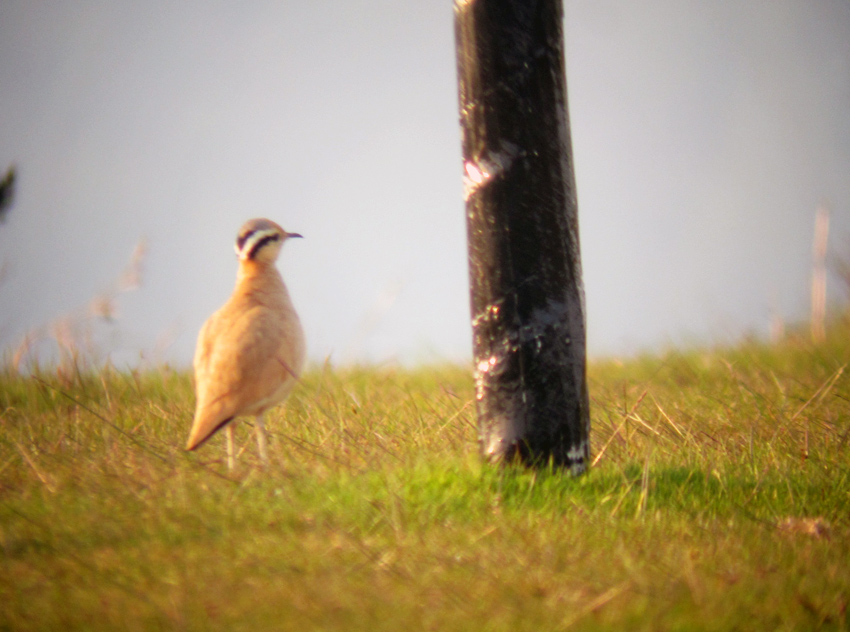
Cream-coloured Courser, Bradnor Hill, Kington, Herefordshire - 21st May 2012

I had a wonderful, long weekend of birding last week, culminating in the best twitch I’ve ever been to – the Cream-coloured Courser in Herefordshire.

The trip around Scotland had been long-planned. Led by Lee Evans, with friends from my January trip: Chris Morgan, Chris Baines, and Mike Warner (thanks for all the driving, Mike!), plus some new acquaintances: John Foster, Mike Robinson, and Paul Steventon.

I travelled up to Stirling by train on Thursday 17th May, and was met by Mike W and Paul to head straight for the Blue-winged Teal at Bridgend Farm Pool, Clyde, on a cold and cloudy evening.

Blue-winged Teal, Clyde, Scotland - 17th May 2012

The next morning we were out early getting great views of Black and Red Grouse, a beautiful male Ring Ouzel, Osprey, Dotterel, Red Kite, Short-eared Owl, while making our way to Braemar to see Ptarmigan.

Dotterel, Kirriemuir, Angus, Scotland - 18th May 2012

We continued northeast as the sun came out, seeing another new duck for me, the King Eider at Ythan Estuary, and then Greater Yellowlegs at the RSPB’s great Loch of Strathbeg reserve. I really didn't expect to Greaterlegs on my year list in consecutive years! Unfortunately, we couldn’t find any White-billed Diver along the cost, so we headed to Grantown-on-Spey for the night.

King Eider, Ythan Estuary, Aberdeenshire, Scotland - 18th May 2012

Displaying King Eider, Ythan Estuary, Aberdeenshire, Scotland - 18th May 2012

On Saturday we wandered the forests in early morning, finding Crested Tit, Scottish Crossbill, Common Redstart, Osprey, and all-too-brief views of Capercaillie. These old forests are such atmospheric places, and occasionally you get a glimpse of the snow-capped peaks that tower over the glens. As we were heading back we found a pair of Parrot Crossbill. The large male, with his low forehead and massive bill, was the brightest metallic orange I’d ever seen.

We stayed around the area for the rest of the morning, watching more Osprey and breeding Slavonian Grebe.

Slavonian Grebe, Highland, Scotland - 19th May 2012

Then we then on our way to the Isle of Skye. We checked into a hotel in Portree, and then went out looking for Corncrake further north. After a few misfires, we found a very showy Corncrake in Uig. You really need to hear their song to appreciate how strong and loud it is.

On Sunday we were out for three hours before breakfast watching a White-tailed Sea Eagle pair, before seeing a Golden Eagle perched high on a crag (my pictures don’t do justice to any of these birds).

Golden Eagle, Isle of Skye, Highland, Scotland - 20th May 2012

After some seawatching (all the common auks plus Manx Shearwater and Common Scoter were seen, but no skuas on this trip), we watched a brilliant Mealy Redpoll flock. The Snowy Owl wasn’t showing on North Uist so we headed south.

The weather had warmed considerably by now, and after some northeasterlies, we decided that the northeast coast of England was the best place to spend the next day. We travelled via Killiecrankie (great views of Pied Flycatcher and Wood Warbler), and Aberlady on the south side of the Firth of Forth. We looked (unsuccessfully) for Surf Scoter off Aberlady, but were rewarded with the most amazing close-up views of a pair of Grasshopper Warbler displaying to one another, down to a metre – the birds moving close to us, not the other way round!

Before we moved on to out hotel in Berwick-upon-Twee, we stopped off at a chippy. It was hear my phone alerted me to the Cream-coloured Courser in Kington, Herefordshire. Whoa!, there was some heated debate about where to go next. We decided on Holy Island and Coquet Island in the morning, seeing White-rumped Sandpiper and Little Stint at the former, and Common, Artic, Sandwich, and Roseate Tern at the latter.

Then the twitch was on. Straight to Herefordshire, straight to Kington Golf course, and straight into a car jam on the approach road! It was getting late (19:30ish), so after some “negotiating” with drivers coming the other way, we were through the traffic and running up that hill.

I arrived on the plateau in gorgeous low sunshine, to see this fantastic bird perform on what felt like a stage, surround by birders and photographs, all stood well back in silence. A very dramatic setting, and well worth the effort. I could go on about the bird, but I’ll let my video and images (poor as they are) do the talking.




After a few beers in the pub to celebrate, we were off to spend the night in Beaconsfield, near London. It was near here on Monday morning I saw my first ever Red-footed Falcon – at Jubilee River Nature Reserve. A fantastic first-summer male (the brown in the wings gives this away), sat preening in a large oak tree.

1st-summer male Red-footed Falcon, Jubilee River NR, Buckinghamshire - 22nd May 2012

Nightingale and Hobby were quickly added to the year list, as were the amazing Firecrests which breed at a site nearby. Another quick look around the nearby reserve at Amwell gave us good views of Cetti’s Warbler, before we were off to Thamesmead, southeast London, for my sixth and final tick of the trip: Bonaparte’s Gull. A distant but distinctive first-summer bird.

The travelled back up north by train, as the others continued on for another five days of birding around Britain. What a great few days: so many great birds, great sights, jokes and japes (though there's always plenty of unnecessary tension on LGRE’s trips), and good friends. Here’s to next year's trip and whatever it may bring!

Wednesday, 2 May 2012

Red-rumped Swallow at Bowesfield Marsh, Cleveland - 30th April 2012

I had a quick trip up to not-so-sunny Cleveland after work on Monday, to see the Red-rumped Swallow at Bowesfield Marsh.

The last time I saw this species was here (you can just see one, the little dot between the clouds and the snowy peak, dead centre)…

TrevĂ©lez, Las Alpujarras, Spain  -  June 2010

…which is not quite the same as a cold, wet, windy, muddy northern nature reserve nestled between a bloated grey river and a soulless, half-built, industrial estate with random uninspiring studio flats. But, the local birders are always very nice and helpful. And the bird itself didn’t disappoint.

It flew close as I watched, down to a couple of metres, allowing great views of the streaky orange chest. The orange/white rump was clear from a distance, making it stand out from the House Martins, as was the dipped-in-ink dark tail.

I’d missed it sat on a post for 20 minutes before I arrived, and I missed it resting on the ground while I went searching the reserve for other birds; but I was very happy with the views I got.

The supporting cast was nice too: I got a brief glimpse of a my first Grasshopper Warbler of the year, along with other year ticks like Sedge Warbler and House Martin. In fact, it was great just watching the hirundines hunting low over the water, through the reeds, and between the bushes. The day got even better when later, as I watched in the pub, City did Utd. Again.

Monday, 30 April 2012

Black-winged Stilt, Frampton Marsh RSPB

Black-winged Stilt, Frampton Marsh, Lincolnshire -  April 2012

A new bird for me, and what a stunner!

A male Black-winged Stilt (though sexing these isn’t totally straightforward), believed to be the same one that was first spotted in Wexford, Eire, on 30th March. This bird has moved steadily east, being seen across England in Oxfordshire, Leicestershire, and west Lincolnshire, before settling at Frampton Marsh RSPB on the east coast.

I arrived quite late in the day, but the sun was out (briefly) and I got some great views having only walked a minute from the car. The bird was sleeping on a distant island, but the identification wasn’t a problem. These are pretty unmistakable. The legs looked ridiculous; but the bird itself is very pretty, enhanced by the smudgy thumbprints on the dainty head.

As I waited for the Black-winged Stilt to wake, I had some great views of a hunting Short-eared Owl, which at time passed close to the stilt. In fact, the stilt woke briefly as the owl passed once – see my video below (at 0:58 seconds). The stilt eventually woke, and I got some lovely views and the photos and video below.


After the BWS had flown off, I had a look round the reserve. As well as early morning, dusk is one of the best times to visit most reserves, and this is certainly true of this one. There was hardly anyone about, and the sun cast a beautiful warm glow over the place. I’d visited here once before – early morning visit on 15th May 2010 to see an Oriental Pratincole. I was impressed with the place then – it’s one of the better RSPB developments.

Among the other birds I saw on the reserve was a striking male Ruff, and an unfortunate female with a broken wing. A Ringed Plover was close enough to the reach out and touch – I counted at least seven, A couple of Wellow Wagtails were a nice addition to the year list, but despite my efforts I couldn’t locate the Garganey or Whimbrel. Well worth the trip though.

Thursday, 12 April 2012

Bird of the year?

It’s April, and so it’s perhaps a little early to be talking of my ‘Bird of the Year’; but I think this just might be the one…

I’ve been lucky enough to see 190 species (using BOU taxonomy) already in 2012, and quite a few sub-species and likely escapes. Amongst these have been super rarities like Common Yellowthroat, Bufflehead, and Western Sandpiper, bogey birds like Little Auk and Richard’s Pipit, and just straight-ahead stunners such as Dark-eyed Junco and Golden Pheasant.

But none on the above sightings compare to the joy of seeing Lesser Spotted Woodpecker in my local wood over the past few weeks. And not just one – a pair.

My Lesser Spotted Woodpecker doodles

There are many reasons why the “Lesser Pecker” is a special bird for me. Firstly, it’s a dapper bird with striking ladder-back markings, the male looking particularly spiffy with his little red cap. They have a distinctive call and a characteristic style when moving around the branches.

Secondly, it’s quite difficult to see - in West Yorkshire at least. It’s undergone a 75% drop in numbers during my lifetime, and is now limited to the south of the UK, with the stronghold in southeast England.

Even if one is present, it’s a difficult bird to pick out. It’s only 14cm long, and can easily hide in the thinner upper branches. Once the foliage grows on the trees you can all but forget seeing it, unless you are know of the nest site.

A few years ago I developed a mild obsession with seeing the male in the woods near my office – a bird that was reported almost daily on my own bird club’s blog. I spent many a morning (and many an afternoon) listening to the drumming and high-pitched call, often just above my head, and not even catching a glimpse of the bird. I struggle now to find the words to describe the frustration I felt…

My notebook from the time details a ten-day period when I made no less than twelve trips to try to see it, including four lunchtimes in one week. I wince now at the times I ran round in circles trying to pin down that squeaky-toy laugh that it has for a call, feeling like the bird was mocking me! Oh yes, the Lesser Spotted Woodpecker was once the bogey bird for me.

Of course, I eventually saw one, on a rainy Saturday morning in 2008. It was the 12th April, four years ago today. I’d been out searching for two hours and was quite wet and about to give up.  As I slowly dragged my feet my across the wood towards home, I saw a pair of Blue Tit flutter from a birch tree up towards a larger beech. Following them was a slightly bulkier black-and white bird, which swooped onto the trunk of the tree. Immediately I picked out the laddering on the back and caught the jerky miniature-woodpecker movement. A female Lesser Spotted Woodpecker! I struggle now to find the words to describe the relief and happiness I felt…

I’ve had several sightings since, of both male and female Lesser Spots in those woods. mostly this year. And the great thing is, I feel almost as happy with each sighting as I did that first time.

UPDATE: Only a couple of days after writing this (14th April 2012), I found another Lesser Spotted Woodpecker - this one in Farnley, North Yorkshire. This one was truly "self-found", being in a wood I'd never visited, or even heard about, before. Chuffed to bits, as they say.

Tuesday, 27 March 2012

Birding the Newcastle AV Festival?

Another interesting weekend, although like last weekend, it was very bird-lite. Practically bird-free. But, at least I can write about some music this time – something else this blog is meant to be about.

Elena Marina at City Park, Bradford, West Yorkshire - Saturday 24th March 2012

I can’t start without mentioning the new City Park which was officially opened in Bradford on Saturday. Brilliant. Totally ace event. Go see the mirror pool if you great the chance.

Well, the clocks went forward on Sunday, and this is my excuse for not getting up early enough and go to look for the local Lesser Spotted Woodpecker. I had other excuses too, but that's the best one. It was a glorious day, more like June than March, so I did some maintenance on the bird feeders in the garden. Is everyone else getting mad numbers of Goldfinches at the moment? 

My wife (let's call her Mrs indiebirder – I'm sure she'll love that!) and I went to Newcastle’s AV Festival on Sunday evening. This year’s festival has a theme of As Slow As Possible, which suits me fine (extremely slow and extremely fast music do it for me). We went to see Attila Csihar: A Scrying: First and Second Action (NCL). If that doesn't sound pretentious enough, it was performed inside one of the towers of the Tyne Bridge; it was cold, dark, and had a whiff of pigeon shit. Mrs indiebirder had the task of reviewing it for the Arts Council, and she asked me to along to provide some “drone-metal contextualisation”.

While waiting outside, we could hear the Kittiwakes making their unmistakeable calls. They nest in Newcastle, and there were a few on the side of our venue.

Kittiwake nests, Tyne Bridge, Newcastle - Sunday 25th March 2012

Inside, we ascended the dank steps to sit on tree stumps around a black pond, upon which were projected suitably shadowy images. Attila did his low, guttural drones from behind a candle-covered table, clothed in robe with cowl. He looped his voice and treated it with some harmoniser effects, creating some excellent hypnotic groves, moving at the pace of tectonic plates. He then would sustain his voice at a higher pitch, using circular breathing, adding his own natural modulation.

Occasionally, Attila would come out from behind his alter to toss some dust into the pool, and raise his hands towards the girders in the atrium above. It was like Coptic chanting meets Aleister Crowley, with some serious sub-bass. At times there were beautiful ambient passages, with natural harmonics being teased out from simple quiet drones: part- part-Moomin, part- plainsong. I loved it. The music was good enough to shine through all the pomposity, perhaps even good enough to justify it.

Flow Mill, River Tyne, Newcastle - Sunday 25th March 2012

A quick mention of Flow Mill moored half a mile downstream of Tyne Bridge. We only had five minutes on here, but well worth a visit. A water-powered instrument ensemble, all glass and wood. You could get some crazy sounds out of it. An adult Cormorant flying low downstream, plus the expected Feral Pigeons and Herring Gulls were the only birds that caught my eye from here.

Gateshead Millennium Bridge, Newcastle - Sunday 25th March 2012

Wednesday, 21 March 2012

Dog bites birder

An interesting few days in the life of the indie birder…

Sicklinghall
 
Sightings: 2 Red Kite, 2 Common Buzzard, 2 Oystercatcher, 4 Mallard, 4 Canada Goose, 4 Coot, 2+ House Sparrow, Chaffinch, Blue Tit, Great Tit, Wren, Robin.

Saturday I was near Sicklinghall, North Yorkshire, where my wife was running an outdoor training course. I spent the afternoon in the woods building a makeshift shelter with some kids. Not many birds around with all the noise going on, but I did get a nice view of a Red Kite nest. No Red Kite nesting there this year, but the farmer informed us they nested last year.

Red Kite nest, North Yorkshire - Sunday 18th March 2012

Keighley
 
Sightings: 1 Old Lady, 1 Dog, 2 Oystercatcher.

Sunday was spent digging out a couple of trees from our garden, to make way for a pond. I volunteered to take the branches and roots to the tip, so I could do a quick recce of a nearby Little Ringed Plover site. They’ve turned up in late March for the past few years, but haven’t successfully bred, to my knowledge, despite trying.

Anyway, before I managed the 100-metre walk from the car to view the site, a Boxer dog attacked me. I was left with bruises and teeth-holes along my right arm, and the poor old lady trying to control the dog ended up in a rocky ditch. I kept calm, which probably helped, and I felt bad I couldn’t go and help the old woman. Thank f*ck I didn’t bring my kids along with me.

She got the dog in her car eventually, and we had a chat. I felt sorry for her, she admitted she can't control the dog. Anyway, I then went to look for the Little Ringed Plovers; but only saw a pair of Oystercatcher before I realised I couldn’t hold my bins properly because my arm was so messed up.

You know, I’m good with dogs generally, and I have a healthy respect after being bitten badly as a child - but overall I like ‘em. But, I had to go to the cops – this dog could do a child some real damage. Without going into all the details, the upshot is the dog will have to wear a muzzle in public, or risk being put down. The cops due to make another visit to the owner next week…

Baildon
 
Sightings: 12+ Mallard, Moorhen, Goosander, Wren, Robin, Blackbird.

Monday, after a trip to the local Police Station to give a statement, I went for a wander along the River Aire from Shipley to Baildon. I found what appeared to be the place where all the local smack-heads hang out, although I was actually looking for a reported Black-bellied Dipper (Cinclus cinclus cinclus). This is the northern European race of White-throated Dipper, and I hadn't seen one before. The UK race (C. c. gularis), which is pretty common around here, has a lovely chestnut-coloured breast.

In keeping with my luck with birds recently, I didn’t see it, or much else  - a female Goosander at the weir in Shipley being the highlight. This was despite being joined by Paul Marfell, who has seen it regularly, including just the day before. I’ll give it another go later in the week.


Dipper (Cinclus cinclus gularis) 
River Aire, Baildon, West Yorkshire (Paul Marfell)   
 
Black-bellied Dipper (Cinclus cinclus cinclus) 
River Aire, Baildon, West Yorkshire (Paul Marfell) 
 

Wednesday, 14 March 2012

March WeBS count

I did the BTO WeBS count of my bit of the River Aire today. A few days after the core count date (Sunday 11th March), but that isn’t a problem. I won’t waffle on. Here’s the list:

84 Mallard (56 male/28 female)
7 Goosander (3 male/4 female)
2 Grey Wagtail
12 Black-headed Gull
Common Gull
Greylag Goose
Canada Goose
2 Mute Swan
2 Moorhen

The non-WeBS species I picked before or during the water bird count were arguably more interesting:

Treecreeper
Nuthatch
2 Goldcrest
Great Spotted Woodpecker
3 Jay
Carrion Crow
3 Mistle Thrush
7 Blackbird
8 Robin
3 Wren
12 Blue Tit
2 Coal Tit
4 Long-tailed Tit
34 Wood Pigeon
Chaffinch
Lapwing
Stock Dove
…and - and - a Lesser Spotted Woodpecker calling in the area. More about this on another post that I’ll write another day.

Probably the most interesting thing was the dead stuff I found...

 Mallard, Shipley, West Yorkshire - Wednesday 14th March 2012 
 
Common Carp, Hirst Lock, Leeds-Liverpool Canal, Shipley, West Yorkshire
- Wednesday 14th March 2012