Friday, 13 June 2014

Spectacled Warbler, Gun Hill, Burnham Overy Staithe, Norfolk - Saturday 7th June 2014

A fantastic bird, this Spectacled Warbler. You can't really ask for more than a springtime singing male carrying nest material, can you?

Way too tricky for me to take photos of it with my cheap little camera, so I gave up trying after the about my 30th shot of empty sueda and just concentrated on getting good views. And good they were. During the couple of hours I was on site, the bird pitched up in various different shrubs and belted out its song. The sun was out (briefly) and the orange legs and contrasting plumage looked great. The rest of the time it was deep in the sueda, giving occasional glimpses as it worked through the brush. Otherwise it was brief flight views before disappearing again for a few minutes.

Plumage-wise, it was like a watching a Common Whitethroat with the contrast and vibrance turned up. The head was darker (more Lesser Whitethroat like), the mantle appeared to have more brown and orange and less grey. The bill looked bigger, perhaps accentuated by the head shape. It looked more correctly proportioned than a Whitethroat, which always look small-headed (and a bid scruffy) to me. And then were the legs: Kia-Ora orange.

Its song was difficult for me to pick out, but seems purer than, less scratchy than a Common Whitethroat. I did here it make a Sylvia-type alarm rattle a couple of times.

I'd actually travelled down on the Thursday afternoon, after a funeral in Leeds. I arrived on site around 19:00, and the bird hadn't been seen for 1.5hrs. The birders on site were all viewing from the salt marsh, looking north into the sueda and dunes (unlike the following day when everyone was in the dunes, looking south). I stayed with the other eight or so birders until the sun went down, picking through the Skylarks and Linnets in vain. A pair of Spoonbill flying over was a nice bonus, if nothing else, as were the showy Sedge Warblers along the sea wall.

Fortunately, my birder friend Chris had space at his excellent B&B in Sheringham, so I shared a few too many drinks with him and got up late on Saturday (08:30!). The bird was still there - and still is at the time of writing: a record 11 days and counting. I had to dodge some heavy downpours, and still got soaked on the journey out and back from Gun Hill, but it was well worth it for this little beauty.

The scene at the Spectacled Warbler twitch, day six...

Tuesday, 10 June 2014

Enter Sandpipers

After using a classic metal album title for my last blog post, I thought I try again for this one. If you've no idea what I talking about, it's a play on words from Metallica's cheesy breakthrough track Enter Sandman. Sorry...

Two sandpipers added to my life list in May, which was nice. First up was a Terek Sandpiper at Covenham Reservoir, Lincolnshire, on the evening of 20th May 2014. Terek Sandpiper is a species I've longed to see, but always assumed if I ever did I'd end up with distant views of a brief coastal visitor. I certainly didn't think I'd get views as good as this.

Terek Sandpiper, Covenham Reservoir, Lincolnshire - Tuesday 20th May 2014

The bird was found on the evening of Monday 19th May, and left mid-morning on Wednesday 21st, so I was lucky I could get there after work on the Tuesday. As I arrived at 19:30 at the northeast corner of the reservoir, the bird was distantly moving south along the east bank, There were a few birders pursuing it, which, I was informed by others already on site, was a thankless task. Best to sit tight and wait. Not such a bad idea as I enjoyed cracking close views of a Yellow Wagtail on the wall in front of me.

The bird eventually flew to the north bank and gradually made its way towards where I was stood. This pattern was repeated a few times while I was there, and only on a few occasions was it clearly the fault of photographers getting too close. Most of the time, the bird was obviously spooked by a gull of wanted to check out a different feeding area.

Most of the time the bird was very active, running along the shoreline at speed, whipping its remarkable bill into the water or at flies close to it. It had an interesting, slightly jerky gait, but was very elegant. Its long legs and bill, and slim, clean appearance was reminiscent of Marsh Sandpiper to me. Although there's no danger of confusing those two: the Terek's legs were bright orange, its grey mantle had a subtle pattern, and the upturned bill was as striking as the guide books suggest.

All the while it was accompanied by a Dunlin, which was busting a gut to keep up. They were occasionally joined by a beautiful summer-plumaged Redshank.

Terek Sandpiper and Dunlin, Covenham Reservoir, Lincolnshire - Tuesday 20th May 2014

Terek Sandpiper and Redshank, Covenham Reservoir, Lincolnshire - Tuesday 20th May 2014

Redshank, Covenham Reservoir, Lincolnshire - Tuesday 20th May 2014


On Monday 26th May, I managed to bribe the family with a day out if I could first go to Nosterfield LNR. The reason? A Broad-billed Sandpiper. Not a big rarity, but a bird that was a more frequent visitor to Britain in the 80s and 90s, since when the sightings have reduced. And, of course, a bird I had never seen.

The weather was lovely, sunny and warm (so it was easy to convince the family to come), though the views were distant. After some great help from @stevejamesPCC to actually get on to the bird, it was straightforward to pick out the ID features. The small size, very short dark legs, stripy head pattern, long straight bill (I could only just pick out the distal downwards kink), grey mantel and yet quite strikingly white below. The gait had a Jack Snipe vibe about it (with no bobbing up and down though). On a couple of occasions it crouched as the Lapwings and Avocets circled noisily overhead.

Too distant for photos unfortunately, but a nice bird all the same. And nice to see it on its second and last day of its stay at Nosterfield.

Tuesday, 3 June 2014

Holy Diver!

Not the classic debut album from Dio, but the White-billed Divers on the Moray Firth. I encountered these my recent trip around the Scottish Highlands over 3rd-7th May. It's taken me a while to sort through my photos from that trip. And now I have, I think these beauties deserve a post of their own.

White-billed Diver, Moray Firth off Portsoy, Aberdeenshire, Scotland - Sunday 4th May 2014

Such striking birds, with their fantastic Great Northern Diver plumage and massive ivory bills held aloft in a similar way to Red-throated Divers. A real highlight of the trip.

We were out on the Gemini Explorer from Buckie - a well-equipped boat complete with a marine biologist on board to help with avian and cetacean ID. This was useful as we saw a Minke Whale and six Harbour Porpoise on the trip too. Recommended.


 Gemini Explorer, Buckie Harbour, Aberdeenshire, Scotland - Sunday 4th May 2014

We also saw several Great Northern Diver, three Black-throated Diver and a Red-throated Diver during the trip, but none close enough to photograph. Plus Common Seal, Guillemot, Razorbill, Black Guillemot, Common Scoter, Eider, Fulmar, Gannet, Kittiwake, Cormorant, Shag, and three Long-tailed Duck in the harbour.

Friday, 21 March 2014

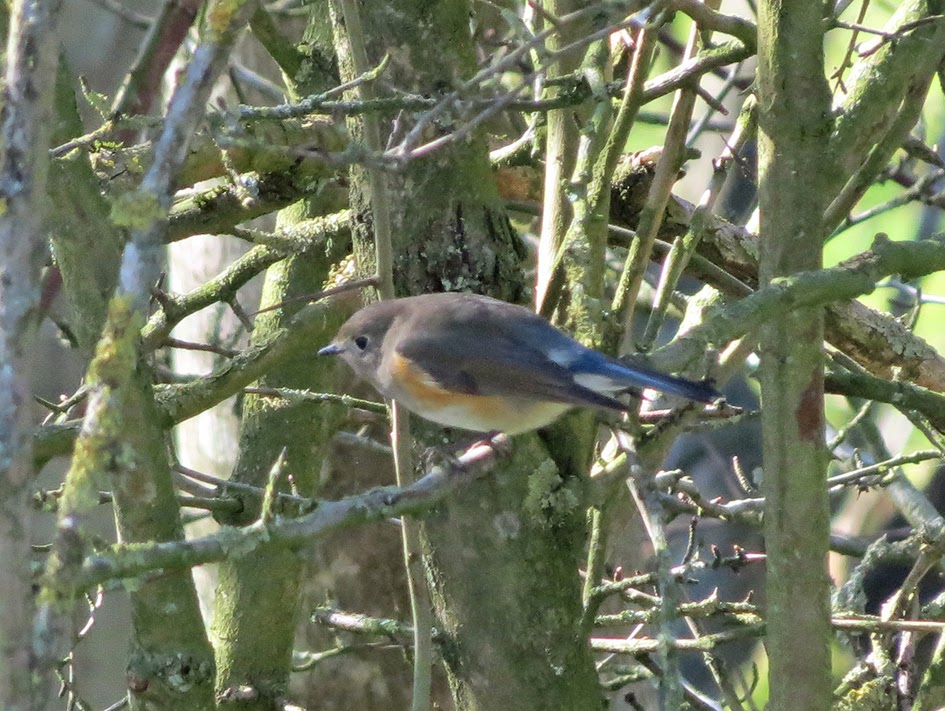
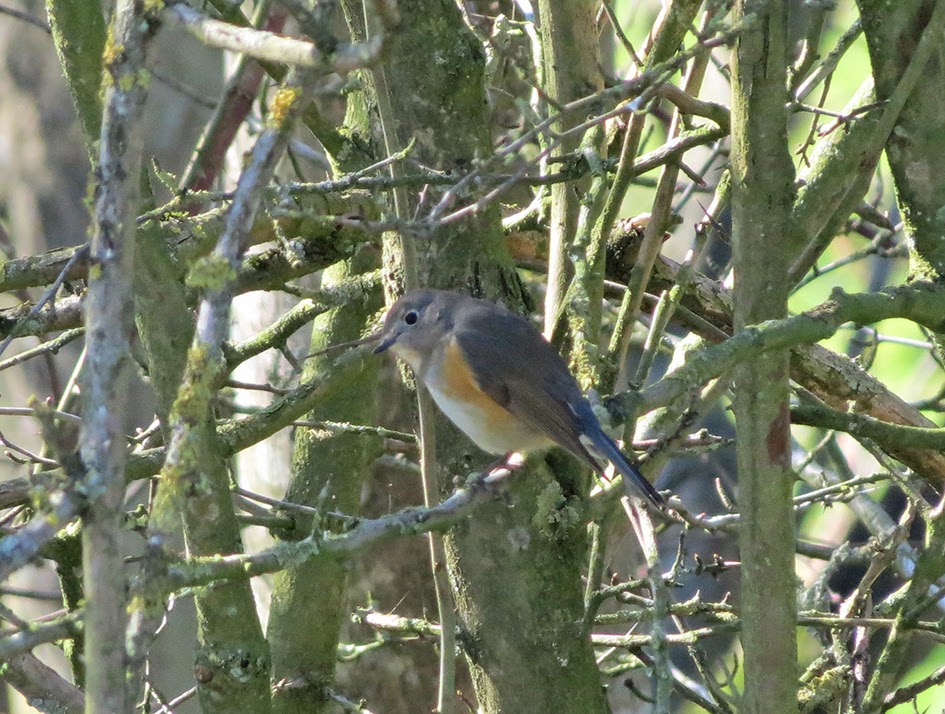
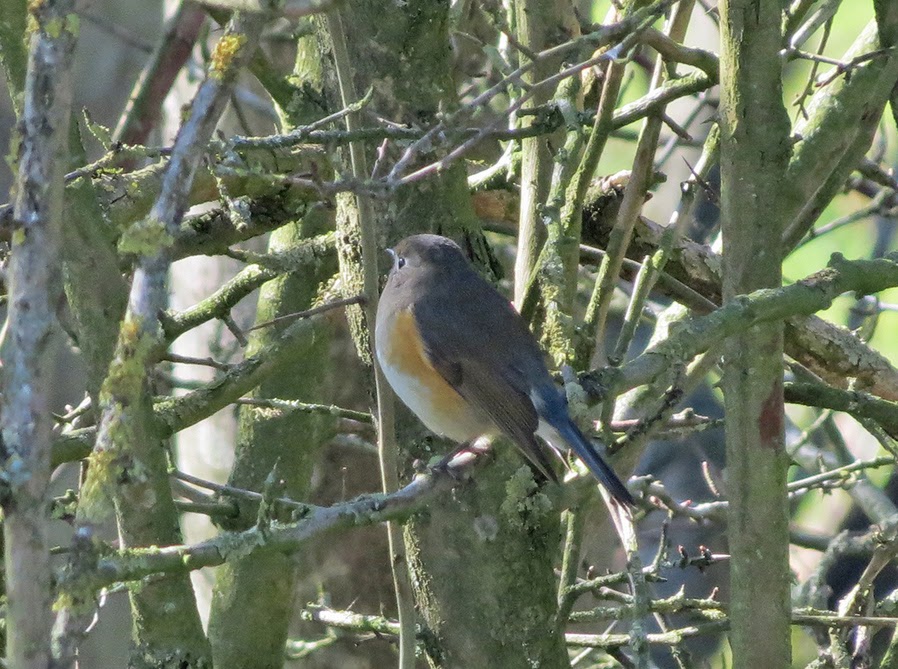
Red-flanked Bluetail - Marshfield, Gloucestershire 9th March 2014

What a stunner! A really lovely bird, especially so in good light as on Sunday 9th March.

Red-flanked Bluetail, Marshfield, Gloucestershire - Sunday 9th March 2014

First found on Monday 3rd February 2014 by John Barnett, who knows how long this bird had been around in the area or the country? I think it's unlikely that it arrived in February directly from its Siberian breeding grounds, getting lost en route to Burma. More likely it had wintered at first on the western side of the continent, or even had been elsewhere in the UK, avoiding detection.

I went to see the bird on the gloriously warm and sunny Sunday 9th March. Most of the others birders on site were photographers, hoping for a good shot in the better light. The late winter had been mild, but mostly overcast and, in the west country in particular, very wet.

The bird performed beautifully, showing well in the bare hawthorn just above the stream. The stream is in a relatively steep-sided vale, meaning observers could be close and at eye-level with the bird.

The good weather and viewing meant I could relax and enjoy the view. I found the bird's plumage fascinating. The "red" flanks were actually a lovely 1970s Kia-Ora orange, like on a Bramling, and often appeared fluffed out. The blue of the tail a rump had an iridescent quality, making it stronger in certain lights and poses. The rump also had small pale patches, just under the wings, which really only showed when the bird was in flight or in certain resting poses. The breast was a soft pale buff, and the wings and mantle were a Robin-like mid-brown tinged with grey. The neck, face, sides of the throat and upper breast were grey, but with an off-white around area bill and throat. It had a strong white eye-ring.

The bird flicked its blue tail frequently, if not constantly, and generally its behaviour was similar to a Robin. It spent most of it's time perched on an inner branch of a hawthorn, no higher than a third of the way up the tree. It would occasionally pick at food items on the branches and on two occasions I saw it flit out to catch flying prey in the manner of a flycatcher. Photographers had placed mealworms on a small grassy mound near its favourite trees, and it came down to these on two occasions while I was there, though the bird seemed to be struggling to swallow the second mealworm for some time.

Red-flanked Bluetail, Marshfield, Gloucestershire - Sunday 9th March 2014

It didn't seem to mind the close proximity of passing birders who used the lower path behind the trees as they left. But whenever dog walkers used this the bird flew off to another clump of trees until the dogs had passed. Two horse riders came along the lower path and one asked what all the fuss was about. When told there was a rare bird in the tree in front of her, she brought the horse round to within one metre of the branch we were pointing at and said, "Here?".  There was a collective groan as the bird flew well away, right upstream. "Not any more", came the deflated response from the twitchers, followed by by a more muted, "you stupid...". Eventually it returned, but not before some newcomers had a anxious wait.


There was a lot of talk on site about how long the bird would stay, prompted by a question form some really friendly and interested locals. I reckoned the high pressure and sunny weather might trigger the bird's migratory urge, or zugunruhe. For once I might have been right, as there was no sign of it the following day, or since. So I was damn lucky to see it when I did. I've tried, and failed, to see this species in Britain before, at Flamborough Head in 2012. That was a frustrating twitch, so this relaxing occasion was all the more enjoyable.

Idyllic...

I hung around in the area for a few hours, enjoying countryside and soaking up the sun as much as birding. There were a few insects on the wing. My first Small Tortoiseshell and Peacock butterflies of the year, along with Red-tailed and Buff-tailed Bumblebee. A Pied Wagtail flew upstream, "chirruping" all the way (a Chiswick Flyover), and Skylarks were singing from their hidden positions right above my head. I saw at least six Buzzards in the area. There was a flock of 40+ Fieldfare at the farm to the north of the Bluetail Valley, which seemed incongruous in the summery weather. As I headed home I called in at another farm to the south of the valley, and found my first Corn Bunting of the year, along with numerous Yellowhammers. A grand day out.

Thursday, 20 March 2014

Yellow-rumped (Myrtle) Warbler - Durham, 11th February 2014

Hmmm, a most interesting twitch…

Yellow-rumped Warbler, High Shincliffe, Durham - Tuesday 11th February 2014

This Yellow-rumped Warbler (Setophaga coronata), or more precisely the eastern form Mrytle Warbler (S. c. coronata), was found in High Shincliffe, Durham, during an RSPB Big Garden Birdwatch on the weekend of 25-26th January. As this species is normally confined to North America, it was understandable the finders didn't know what it was. The gave it the rather ace name of "Flora Butterbum", and had the wherewithal to send photos to the RSPB. Once they were told just how rare this birth was (only 30 accepted records in the British Isles at the time, and only half of those in the UK itself), the question turned to access for twitchers. This took some negotiating, but eventually access details were released on the 9th February. Read the finders account here.

I'd taken the Tuesday afternoon off work to go for this beauty, which was the first opportunity I had, and travelled up on the train. Not the first bird I've twitched by train (that was a Black-crowned Night-heron at Fairburn Ings some years ago), but undoubtedly the best. I also managed to tick this Bittern at York Station on the way up…

Bittern, York - Tuesday 11th February 2014

There were a few glum faces among the 20 or so twitchers as I arrived - the bird hadn't been seen for over 1.5 hours. I joined the search, scanning the trees opposite the "grassy knoll", and after five minutes I became aware of call, a soft repeated "chip" or "chirp". I couldn't pin-point it (my hearing is terrible), but fortunately another birder had better stereographic projection than the rest of us and he pointed at a sparrow-sized bird calling from the very top of the tree in front of us, "Is that it?". Bins out, scopes on… "Yes!"

Yellow-rumped Warbler, High Shincliffe, Durham - Tuesday 11th February 2014

It soon flew off, but came back to the trees several times during the two hours I was there, including a few long stints on the coconut feeders and the base of the trees. The video below illustrates the viewing conditions. The feeders had been provided in an attempt to lure the bird out of the finders' garden and allow birders decent views.


At first glance the plumage was relatively drab, but closer inspection revealed a really interesting bird. It was large for what we call a warbler. The uppers were grey-brown with, according to my notes, a suggestion of rufous tones in some lights. The back was clearly streaked, as were the flanks and breast. The underparts were a grey-white. It had large white eye-rings and a hint of pale supercillium. There was a bright lemon-yellow patch on each flank and a clear yellow patch on the rump. This last feature wasn't always visible, but really shone when on view. I think the consensus was this was a first-winter male.

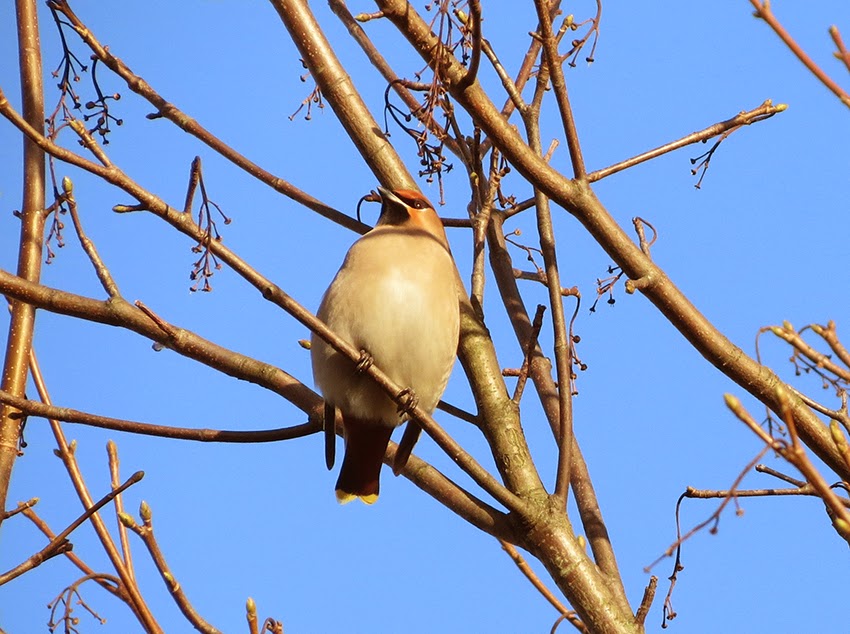
There were three Waxwing around 200 metres further along the road from the feeders. The sun was out now and I managed some better shots than I did of the Myrtle Warbler…

Waxwing, High Shincliffe, Durham - Tuesday 11th February 2014

The Myrtle Warbler wasn't so easy to photograph, especially as it spent most of its time on feeders partially obscured by tall dry grass. The auto-focus on my camera couldn't cope, but I resisted the temptation to get too close ...unlike some.

Just a little closer...