Monday, 27 January 2014

Norfolk and Suffolk, 17th-19th January 2014

The third weekend of the year and it's another weekend devoted entirely to birding. That's 3 of out 3 for 2014. That can't last...

This time it was three days in Norfolk. It's always a pleasure coming down here in winter, and especially when staying at my mate Chris's tip top B&B Providence Place in Sheringham. I took the Friday off work and set off from home around 05:00. As ever with early starts, the first bird heard was a Robin singing at the services on the A1 in Nottinghamshire.

I arrived at Wolferton Triangle (just west off the A149, south of Dersingham) just after dawn and kerb-crawled for the elusive Golden Pheasant while dodging Munjacs. It did take long before it showed on the north side by the crossroads sign (as last year). I say "it" because as far as I can tell there have been no reports of two birds being seen together once 2010 when two adults were seen. One of those was probably the immature bird seen in 2006. I've seen one bird every year since February 2010, when I thought I may have seen two separate individuals. The lack of females and I matures seen recently suggests the species' days are numbered, at this site at least. Either way, it such a striking bird and worth checking on if you're passing.

 Golden Pheasant, Wolferton, Norfolk - Friday 17th January 2014


I called in a few sites as I headed for Thornham Staithe: 19+ Curlew by the A149 near Norfolk Lavender; 50+ Oystercatcher on the grass at Hunstanton cliffs car park; 2 Red-legged Partridge at Ringstead. Thorham itself was quiet. The tide was out, so the waders were too. Plenty of Dark-bellied Brent Geese and Shelduck around though, and my first Meadow Pipit, Little Egret and Marsh Harrier of the year.

Titchwell was relatively quiet too, both in bird and human terms, though on the same day last year I was the only person on the reserve for a time. A couple of Marsh Harrier were the only raptors I saw. The waders were good, with Avocet (20), Lapwing (1000+), Snipe (2), Black-tailed Godwit (30+ on Freshmarsh), Bar-tailed Godwit ("a few" on the beach), a single female Ruff, plus Golden Plover, Dunlin, Redshank... Plenty of Pintail, Shoveler, Teal and Wigeon around, and (perhaps surprisingly) my first Tufted Duck and Pochard of the year. The distant sea had 300+ Common Scoter (I could not pick out any Velvets, especially with the very choppy sea being so far out), 8+ Goldeneye, Red-breasted Mergansers, a probable Black-throated Diver in the distance. Highlights were the ten Twite feeding on the mud and the showy Water Rail in the ditch near the visitor centre.

 Water Rail, Titchwell, Norfolk - Friday 17th January 2014

 What's left of the boardwalk at Titchwell - Friday 17th January 2014

Next stop Holkham for some goose action. Shed loads of Pink-footed Goose plus Greylags all around Lady Anne's Drive. A cluster of White-fronted Goose in the corner were the best sight. I love watching geese.

The light was fading and I decided I'd have a crack at the Glossy Ibis being reported at Cley. I checked over the fields from Wiverton to Cley windmill in vain. The gen on the ground was the bird was tricky and hadn't been seen all afternoon. At that moment it was reported going to roost north if the A149. A search up that way brought only the dependable Barn Owl hunting low over the reeds and dykes. Not a bad day. Then it was off to Chris and Wendy's for as much booze as I could swallow…

After cooking me an awesome breakfast on Saturday, Chris joined me for a day of birding. We'd planned to start in the Yare Valley for Taiga Bean Goose;  but there hadn't been any reports of the geese being in the traditional sites around Cantley and Buckenham, perhaps due to the mild and wet weather. The only Bean Geese reported were at Minsmere in Suffolk. It was bit further than we'd hoped to go, but off we went (getting a cracking view of a roadside Barn Owl in a dead tree as we did).

Despite being mid-morning by the time we arrived, it still hadn't really got light. The Scrape at Minsmere was relatively quiet with only the expected ducks, Lapwing and Dunlin. There was no doubt more hiding in the gloom somewhere, beyond my scope tolerance. We headed to the sluice gate on the sea wall and looked over the South Levels. Plenty to see, but very distant. Fortunately, someone had picked out the three Taiga Bean Goose already and got us on to them. They were sleeping on the water (never seen a Bean Goose swimming before), but one did wake up and show us its long dark neck. A Peregrine was sat on a nearby post, casting its eye around. We now had gen on some winter swans from nearby Whin Hill, so headed back to the car by a different route. 

View over Minsmere from the sea wall - Saturday 18th January 2014

Around ten swans were relaxing in the far distance from the levels from the Whin Hill watchpoint. Most had their heads in, so differentiating between Bewick's and Whoppers was going to be tricky/impossible. It was possible to check the two which were up and feeding. These had log necks and noticeable yellow on their bills, so Whooper Swans they were. Chris hadn't been out birding yet this year, and was lapping up all the year ticks, both easy and hard (Bean Goose, Robin, Whooper Swan, Moorhen, etc)...

We headed north up the coast to Great Yarmouth for traditional wintering sites for Mediterranean Gull and Snow Bunting. Just as we headed past Pakefiled (south of Lowestoft) a report came in of a Snow Bunting flock on the beach there - perfect timing. The flock of 30+ (the report said 60) was easy to find, as they were being flushed by dogs and their owners. The black-white-brown pattern as they fly is a joy to watch. I suspect the ground had been seeded as the flock kept returning to one small area time and again.
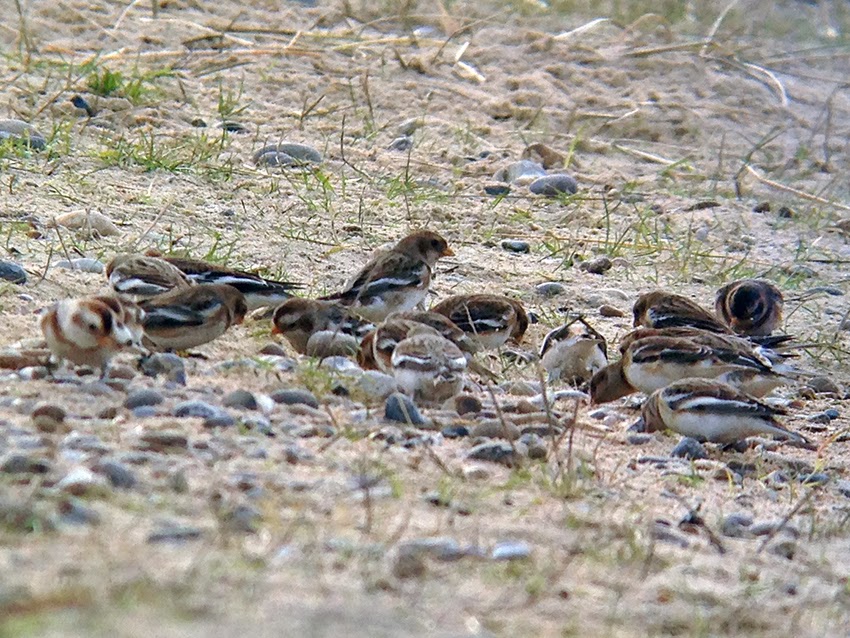
 Snow Bunting, Pakefield, Suffolk - Saturday 18th January 2014

We tried unsuccessfully for some reported Shore Lark north of Great Yarmouth, getting only Skylark for our trouble. Then watched Mediterranean Gulls around the pier while we enjoyed chip buttes.

We got to Stubb Mill in good time (I hadn't dropped my phone in Great Yarmouth this year, so didn't need to double back…), and from the crowded viewpoint had 20+ Marsh Harrier come in to roost. I didn't see a Han Harrier come in, but a guy to my right claimed one. We had decent views of a Common Crane on the deck. Collectively the crowd could see three birds on the ground, but we could only see one. No matter because as we returned to the car park we heard Cranes calling and looked up through a fortuitous gap in the hedge to see two flying in low over the field. One of the best views I've had of these in flight.

Sunday started with an even more awesome breakfast from Wendy. D'ya know, a lot of birders get really sniffy about other birders mentioning their breakfast in their blogs. "It's mostly about what he had for breakfast, and hardly any mention of the birds, blah, blah...". Well, whatever. Here's my "Dude's Breakfast", as a good fry up before setting out should be called:

Yum yum...

First target was the Cley Glossy Ibis, which proved pretty straightforward, despite the heavy rain. It was feeding in the field by the road just northwest of the Three Swallows pub. A bit distant to photograph, and too far and too wet to appreciate the glossy plumage. Always a nice bird to see though. We then continued the twitching vibe with a trip to refind Parrot Crossbills at Edgefeild near Holt. The sun had come out by now, but this didn't help us find any type of Crossbills in what was a large area. Two Red Kite, two Common Buzzard, Goldcrest and Treecreeper were the best (only?) birds we got.

Having done a lot of the coast on Friday and Saturday, we decided a trip to Sculthorpe NR was good bet. A great site for woodland birds, with the bonus of a decent reedbed too. There were two male and two female Bullfinch, and plenty of the common finches and tits, on the first feeders in the woodland, usually a good spot for Marsh Tits.  In the wood we eventually picked up a couple of Marsh Tit calls among all the Nuthatch noise, getting good views. Some Siskin were feeding with Goldfinches high in the birches, and a Redwing flock flew through.

 Bullfinch, Sculthorpe, Norfolk - Sunday 19th January 2014

The reedbed hide is great for Brambling in winter, with 20+ coming to the bird table while we were there. The obligatory Water Rail too. No Coot though. Still had seen one all year…

 Brambling, Sculthorpe, Norfolk - Sunday 19th January 2014

 Water Rail, Sculthorpe, Norfolk - Sunday 19th January 2014

Chris and I went our separate ways, and I decided to head for home, but not before calling in at Abbey Farm at Flitcham, hoping for a Little Owl. The only owl I got was another Barn Owl, way off behind the big Greylag flock. The flock was noisy and restless, with small groups flying in and out. A group of five flew up and I picked out a noticeably smaller Pink-footed Goose going up with them. I love watching geese.  I noticed in the sightings book a Coot had been seen earlier that day - year-list mega! In the hour I'd been there I'd seen eleven Moorhen on the tiny pool in front of the hide, and no Coot despite actively searching for one. I stayed on, watching Red-legged Partridge amble past as the sun went down. And then, finally, a Coot surfaced right in front of me, as if by magic. Ah ha! Brilliant. Better than that American Coot, that was.

 The rural idyl that is Abbey Farm, Flitcham - Sunday 19th January 2014

Tuesday, 21 January 2014

A new birding year

So, 2014. A new birding year. Plenty of resolutions to act on (more patch-birding, religiously using BirdTrack, submitting all my local records to BOG, doing the Patchwork Challenge at Rodley NR, losing weight, etc), but the main one is: being happy. And the things that make me happiest are: spending quality time with the kids, and birding.

The first one is all well and good, but when a rarity turns up, thoughts turn to how best to see it, even if it means a trip away from the kids and spending birding time in a car. Sad, I know.

The rarity in question this time was an American Coot. It was (still is, at the time of writing) on Loch Flemington, between Inverness and Nairn, Scotland. I'd seen these before in California, late 2011. Let's be honest, these are not birds that set the pulse racing. But an addition to my British life list so early in the year, and a species which seems to prefer Ireland on the rare occasions it does get over here, was just too good to miss.

After some horse-trading at home, and plans with car-sharing birders being drawn, ripped up, and redrawn, I set off north at tea-time on Friday 10th January. Secret Twitcher Joel generously drove us there and back (I think he doesn't trust my driving), and booked us into a hostel in Inverness for the night. Luxury twitching.

We were at the loch by 08:45, and on the bird very soon after. The light was poor (dawn is later up north in winter than down south), and the bird could go missing in the gloom and reeds. But, for the most part it performed nicely on the water, occasionally doing its chicken-like walk across the cut reed bed.

The key ID point for distinguishing a Eurasian Coot from and American one, at least at a distance, is the presence of white undertail coverts on the latter, which it often flicks (more like a Moorhen than a Eurasian Coot). In fact, the bill shape maybe be more Moorhen-like too, being narrower and taller.. The bill's colour is, of course, white, but with a grey-black smudgy vertical line near the tip. There's a small red patch on the forehead, and deep red eyes.

My photos are a bit shabby - I really should use a tripod in poor light.


American Coot, Loch Flemington, Highland, Scotland - Saturday 11th January 2014

The loch was other wise quiet, bird-wise, with just Moorhen, Mute Swan, Cormorant and Goldeneye in view. Another birder picked up a family of three Otters frolicking on the far bank, behind the Goldeneye. Lovely stuff. And a small skien of Pink-footed Goose flew over our heads low south.

We headed off for breakfast and joined up with a crew from Leicester (including Colin and John who I'd met on North Uist last year, plus the ubiquitous Chris Bromley). We headed to the nearby Alturlie Point to find a reported Lesser Scaup female. Just about every Greater Scaup in the flock was asleep, head tucked in, as we tried to pick out the Lesser in vain. Plenty of other delights though: at least three Red-throated Diver, three Slav Grebe, five or more Long-tailed Duck, Red-breasted Merganser, another Otter, and a low-flying Red Kite over the car.

We headed to Ardersier for a first-winter Iceland Gull, picking it out as it came over the houses to land in the diary farm, Milton of Connage. We watched a couple of Rock Pipit, Turnstone, Knot, Curlew, etc., on the beach before the weather came in and we moved on.


Iceland Gull, Ardersier, Highland, Scotland - Saturday 11th January 2014

Joel needed to get back early, which gave us just enough time to check through some huge Pink-foot flocks for Snow, White-front and Bean Geese (finding a start Greylag only) before heading south. A nice easy twitch, especially for me-the-passenger. Joel had to contend with my ceaseless withering and a heavy defeat for Leeds United as we drove home.

The view from the A9

I started my birding year over the first weekend in January with a four-day family trip to Robin Hoods Bay, near Whitby in North Yorkshire. To be honest, I didn't do a great deal of birding -  it was mostly rock-pooling with the kids, plus walking, drinking, and sleeping. But I did go out first thing each morning, getting great views of 17 or more Purple Sandpiper on the beach at high tide. Unfortunately, they are very difficult to photograph in the poor light at dawn, especially when they match the colour of the wet rocks they're stood on.

Purple Sandpiper and Turnstone, Robin Hoods Bay, North Yorkshire - Friday, 3rd January 2014


Purple Sandpiper, Robin Hoods Bay, North Yorkshire - Friday, 3rd January 2014

These weekends away have meant I haven't yet visited the patch I registered with Patchwork Challenge. It looks like the first visit I'll make this year (and the only one in January) will be on 26th January. That'll have to be in the afternoon after an Airedale Otters event. So much for "getting out on the the patch a bit more in 2014".

One of my birding resolutions: Tidy up my note-taking - old style left, new style right.

I have managed some birding from work at dinnertime (or lunchtime if you prefer). The river and canal which go through Saltaire have Little Grebe and Goosander in winter, and Grey Wagtail is rarely far away. The park and playing fields are good for Fieldfare and Redwing, and the nearby woods have Nutchatch and Treecreeper. The water treatment plant at Dowley Gap is just reachable on foot and back within an hour, and it was here I got my first Goldcrest and Chiffchaff of the year. A few more trips should bring Dipper, Mandarin Duck, Great Spotted Woodpecker and maybe Lesser Spotted Woodpecker.


Robin Hoods Bay, North Yorkshire - Sunday, 5th January 2014

Friday, 27 December 2013

Ivory Gull, Patrington Haven, East Yorkshire - 17th December 2013

 Ivory Gull, Patrington Haven, East Yorkshire - 17th December 2013

What a scorcher! This fabulous juvenile Ivory Gull was first found eating rotting fish on the afternoon of Sunday 15th December (after being present for a few days, according to local fishermen). The enterprising Martin Garner and his friends decided to put some more fish out for it on Monday morning, in the hope of attracting back - with some considerable success.

I saw the gull the following morning (after asking permission for the mooring off from my understanding boss), and the bird went on to stay until Christmas Day. There are many accounts of this bird on the web already, so I won't go on and on; suffice to say it was a wonderful bird to witness.


 Ivory Gull, Patrington Haven, East Yorkshire - 17th December 2013


The Ivory Gull on the roof of the pumping station

 The scene as I was leaving

Monday, 23 December 2013

Two top ticks

Western Orphean Warbler, St Brides, Pembrokeshire and Two-barred Crossbill, Forest of Dean, Gloucestershire - 17th November 2013

2014 has been an astonishing year for rare birds in the UK, and the month of November was no exception. The best bird of the month (for me) was a surprise Western Orphean Warbler (aka WOW), masquerading as a Lesser Whitethroat in the back garden of Orlandon Kilns in Pembrokeshire, Wales. The bird was re-identified from photos originally labelled as Lesser Whitethroat by an eagle-eyed reader of the Pembrokeshire Bird Blog.

I'd missed the Cleveland Western Orphean Warbler in May 2012 for reason I won't go into (suffice to say my wife's allotment is in great shape…), so this was a species I was desperate to see. The "Lesser Whitethroat" had been around a few days before being publicly announced, so there was a good chance the bird was settled… And the bird did indeed stay, and owners Peter and Rosemary Royle generously opened their back garden to twitchers, with locals on hand to help with parking. Twitch on!

So, on the 17th November I was up at stupid o'clock and making a twisted and tortuous satnav-led journey across Wales to arrive before sunrise. Actually, I was quite happy the TomTom took me along unnamed country roads and farm tracks, as it allowed me to year-tick Tawny Owl as one flew out above the car. And not only that, I also saw my first live Badger as one snuffled across the road in the beam of my head lights before disappearing under a hedge. So I was already on a high when I arrived at the remote rural junction by a dairy far 30 minutes before dawn, to be ushered into a field which was doubling as a car park for the duration.


Local volunteers corralled us, then quick-marched us to the house along a twisty country road like Team Sky leading a bike-free peloton. We were shown to a slate-covered driveway, unfortunately a little noisy underfoot, and all gazed into the orchard in the Royle's garden.

 Western Orphean twitch - 17th November 2013

A few Blackbird, Goldcrest, and Blue, Great and Long-tailed Tit were around at first, with Pied Wagtail swooping around too. Black-headed and Herring Gulls sifted overhead, along with the odd cranking Raven. Then the guy stood to my left pointed and said in a strong whisper, "There, on the horizontal branch!", and I was on to it - a male Western Orphean Warbler.

The bird was a typical sylvia-type warbler, though not as striking as the Sardinian Warbler I'd seen recently - the colour contrasts weren't as great.. This bird looked like a garden warbler dressed as a Lesser Whitethroat. Chunky, big-billed and with a pale eye-ring. The head was mid-grey, rather than pencil-black I'd expected, and the breast, belly and flanks were an almost warm grey turning to  a tea-stained sandy brown nearer the tail. It posed for a while at the back of the garden (of course, I hadn't got my camera out of my bag at this point) before moving closer into the apple trees. Views for more difficult here, and we had to wait for it to fly up to the larger tree before we could get clear views again.

After getting plenty of tickable views, including a look at the plain undertail coverts, I attempted to get a photograph…


Western Orphean Warbler - St Brides, Pembrokeshire, 17th November 2013

Perhaps the less said about that effort the better. Definitely one for "Crap Record Shots of the Year 2013".

The volunteers managing the flow of people through the garden asked if those who'd had got good views already could move on to allow more people in. So I moved on and decided to head home via the Forest of Dean in Gloucester, in the hope of seeing Two-barred Crossbill.

Regular readers will be aware of my fruitless attempts to see this species this year. Dips at Broomhead Reservoir in South Yorkshire (three times), Hemsted Forest in Kent (where my camera was drowned in the rain, never to work again), and Thetford Forest in Norfolk (which at least was redeemed by a Brown Shrike tick), had left me wondering if these birds actually existed and if Britain was awash with serial Crossbill stringers…

I struggled to navigate through the Forest of Dean, both in the car and on foot, but finally came upon two dozen or so birders looking across a clearing. There had been a reported sighting earlier in the day, so I was feeling confident, especially with these extra eyes and ears about. "Any luck?", I asked, cheerily. "Nothing all day," said one, "Not a peep in five hours," said another. Um, great. I moved further up the track, as something about the taller trees (with big fat cones on) looked better for crossbills than the birch-filled clearing.

Within a minute of moving onto the track I heard the familiar "chip, chip" of Common Crossbills, but with an odd additional toy-trumpet parp. That must be them I thought, and we all looked at each other as if to say, "Did you hear that too?". Crossbills landed in the tree-tops around us, but we couldn't pick out any Two-barreds. There were loads of Siskin around too, flashing their wing bars. Crossbill flocks continued to bounce and call around over our heads, occasionally with Two-barred parps being clearly audible. Eventually a large flock landed in view, and stayed a while to feed. Before long we'd picked out two male and one female Two-barred Crossbill. Success at last!

These were easy to ID, with no doubts about them being wing-barred Commons. The white wing-bars were big, bright and clear, as were the tips to the tertial feathers. Plus there were the calls. Unfortunately, the trees were tall and space to move back limited, so viewing and photography wasn't easy, but here's my best effort (and possible my second entry into "Crap Record Shots of the Year 2013").

Two-barred Crossbill - Forest of Dean, Gloucestershire, 17th November 2013

 Getting good views involved some comedic chasing around

A great day of twitching, with two lifers (three, if you include the Badger), and a fair bit learnt about sylvia warblers and crossbills.

Monday, 11 November 2013

Hermit Thrush, Porthgwarra, Cornwall - 1st November 2013

I was extremely fortunate to see this Hermit Thrush at Porthgwarra, Cornwall - the first ever record on the British mainland - and was possibly the last person to see it too. With only eight previous records (all on UK islands - Scilly, Shetland and the Outer Hebrides - plus a further two in Eire), if you wanted to see this species in the UK (without involving sea crossings) this was your chance.

This bird was found on Tuesday 29th October, while I was on a half-term holiday with the family in Lancashire. My earliest chance to get to Cornwall was on the Friday 1st November, so I took it. I got up practically before going to bed, and set off aiming to arrive not too long after sunrise. I received a message that the bird had been seen early morning and watched on and off for about an hour; but I was still an hour away when this news came through. When I arrived the bird hadn't been seen that last sighting.

When I arrived the birders were all strung out along the roadside. As with any twitch where you arrive and the bird's not currently showing, you have to find out as much gen as possible about the last sighting and then choose a strategy for how and where to concentrate your search. Almost all of the assembled birders were viewing the wood that covers the lower part of the ravine: either at the lower end, where the bird's (apparently) favourite area was, or nearer the top, where the bird had been seen last (at around 08:45). But, I'd been told the bird had been seen moving up the hill, through the wood, then beyond it until lost in the undergrowth and trees further back from the road. Searching around the top end seemed to make most sense to me.

Another birder seemed to have the same idea as me, and around 11:00 together we spotted some movement around the hedge in a garden. He asked me if any Song Thrushes had been seen that morning - I said I hadn't seen one, or heard from anyone else - and he said he thought he'd seen something a bit Song-Thrush-like fly up from the road into the hedge. We checked the garden and soon saw movement in the undergrowth in a rockery on the far side (about 10 metres away). After a few minutes we'd drawn a blank and I started looking in the hedge itself. I immediately found the outline of a thrush, which flew into the garden. I went to the gate to find the other birder pointing across the garden to an area under a large tree. "There!" he said.

We could see the bird very clearly through three vertical stems of a shrub. It was stood on a mound of mud or rock or wood, under a conifer, the base of which was surrounded by evergreen shrubs (rhododendron, laurel, tamarisk, and the like), which really blocked out the light. It was the Hermit Thrush.

The bird was very alert - staring right at us, with its tail cocked and wings drooping. It cocked its tail a few times as it continued to look at us, but I didn't hear it call. The two of us talked through the ID points to make ourselves sure of what we had.

The bill was dark and on the small side. The face was a uniform brown, mostly plain - a little paler in the lores - with a very clear pale eye-ring. The head and mantle were a uniform dull brown. The underparts were a slightly dirty-looking off-white, contrasting strongly with the brown uppers. The breast markings were very striking: the black spots were very blotchy and were only present on the throat and upper breast. There were no spots on the belly or flanks. The legs were clearly pink (which is where my doubt crept in as the photos I'd seen on the backs of a couple of cameras that morning appeared to show a bird with dark legs - a trick of the light. In my tiredness I'd forgotten the legs should be pink!).  The legs appeared long, perhaps because of the bird's alert stance. Stupidly, I didn't pay too much attention to the tail - I didn't notice the red coloration (it was so dark under that tree), although the other observers said they had when we discussed the bird later. The overall impression was of a fat, round-bellied thrush - the best description of the shape would be a big fat Nightingale who'd spilled its dinner down its front.

As we discussed what we were looking at I waved to the nearest birders, but they were some way down the road. I couldn't make too much commotion - the bird was so close and alert to our presence. I attracted the attention of the nearest birder who quickly came to our side. He said immediately, "That's it!". It turns out he'd seen it this morning and on previous days. I turned to beckon more birders up the road, and a few started to walk/run towards us; but as I turned back, the bird skittered off to the left and out of view. Only three of us had seen the bird...

There was some further movement in the undergrowth, but no further sightings. That was it. A few birders continued to watch the garden for a while, but people soon drifted back down to the wood, hoping it would show in the usual place again.

On site at the time, I felt acutely aware that almost everyone had missed it. It didn't show again that day, or the following day (a Saturday) for the many more birders who made the long trip. Not a pleasant feeling I reckon (but one I'm familiar with myself).

So around 12:45 I decided I'd head for home. I found a phone signal as soon as a could (just as I reached the A30), and rang the sighting in to BirdGuides. I was a little angry at myself for not having a camera with me (mine was damaged in Kent after my Semipalmated Plover twitch), and was feeling annoyed that we didn't have a photo of the sighting.

I have photographed this species before, when visiting North California for work in December 2011. Not easy birds to photograph, even where they are abundant...

Hermit Thrush - Sunnyvale landfill, California, USA,
Wednesday 7th December 2011

So, another successful - if tiring - twitch, which is quite nice after all the dips I had in Spring.

Wednesday, 6 November 2013

Sardinian Warbler - Mire Loch, St Abbs Head, Borders, Scotland - Sunday 27th October 2013

My wife's been so busy of late that I've been practically the sole parent of our children over the last few weekends. This has meant for some fun - but very tiring - times. And for very little birding or twitching. So I took the whole of half term off work, hoping to spend some quality time with the family and get some birding in. As ever, I didn't get out to do much birding during the week, but did squeeze in this fine day of twitching…

On Sunday 27th I left home some 2.5 hours before dawn, to arrive at St Abbs Head NR, Borders, Scotland, around half-an-hour after sunrise. I was after a male Sardinian Warbler - a real looker from the photos I'd seen. I'd received some great on-site directions via Twitter and needed to get to the car park at the starting point of those directions. But, the gate to the reserve appeared locked, so I parked outside the reserve and walked up to the car park on the far side of the reserve. Turns out the gate wasn't locked - it just looked that way - so I had added around an hour to my trip… Ah well, I did have a lovely walk through this dramatic reserve.

I took the long route...

When I got to the bushes, I found there were five of us early-risers looking for this bird. A couple of the guys had already seen it early doors, giving me hope that it would soon show again. The weather was so lovely - bright, sunny, still, cold but warming up - which added to my optimism. The bird was apparently favouring the sycamores, birch, blackthorn and gorse, rather than the nearby pines; but you could tell what it was favouring when it was completely out of view and off the radar for 99% of the time?

 Just a handful of people looking for this bird

There were a few other birds in the area: Chiffchaff, Blackcap (which give us some raised heartbeats on a couple of occasions), Goldcrest, Robin, etc, with Redwing, Fieldfare, Reed Bunting, and Yellowhammer occasionally alighting higher in the trees. As I waited I watched the tumbling Ravens over the loch and picked out a beefy-looking Peregrine glide stealthily overhead.

Before long the Sardinian Warbler popped up, although I missed it the first time - I was checking another area. Once I'd got my eye in, I got great views. The striking white throat of the bird really stood out against the black hood and gunmetal-grey of the mantle. The tail was often cocked while the bird perched on a favoured birch branch, where it was often stationery. The red eye-ring was very clear. The bird showed well three times while I was there, and I only left because the weather was turning wet. A real cracker of a bird, making me annoyed with myself for damaging my camera in Kent the the previous week.

This is a species I've seen before, but only in Spain in 2010, while on holiday with the family. I did manage some photos of Sardinian Warblers then, though not of a male.  Not an easy bird to photograph in deep cover - here's my best digiscoped attempt of a female from that holiday.

Sardinian Warbler (female) - Orgiva, Spain, 11th June, 2010

There are some good shots of the St Abbs Head / Mire Loch bird here, here and here.

As I travelled home the rain eased and I decided I'd try Hartlepool Headland for the Western Bonelli's Warbler, again. The rain may have gone, but the wind was now up - this was at the time of the southern "Great Storm". I managed to scan every tree, bush and shrub in the gardens and park and see absolutely nothing, just as the other birder on site had said I would. God know how the the bird found later (well after I'd got home).

I did have the consolation of getting good views of this Glossy Ibis in nearby Hartlepool, in a flooded paddock at the end of Valley Drive. Some iphonescoped attempts in high wind…

Glossy Ibis - Hartlepool, Sunday 27th October 2013