Wednesday, 21 March 2012

Dog bites birder

An interesting few days in the life of the indie birder…

Sicklinghall
 
Sightings: 2 Red Kite, 2 Common Buzzard, 2 Oystercatcher, 4 Mallard, 4 Canada Goose, 4 Coot, 2+ House Sparrow, Chaffinch, Blue Tit, Great Tit, Wren, Robin.

Saturday I was near Sicklinghall, North Yorkshire, where my wife was running an outdoor training course. I spent the afternoon in the woods building a makeshift shelter with some kids. Not many birds around with all the noise going on, but I did get a nice view of a Red Kite nest. No Red Kite nesting there this year, but the farmer informed us they nested last year.

Red Kite nest, North Yorkshire - Sunday 18th March 2012

Keighley
 
Sightings: 1 Old Lady, 1 Dog, 2 Oystercatcher.

Sunday was spent digging out a couple of trees from our garden, to make way for a pond. I volunteered to take the branches and roots to the tip, so I could do a quick recce of a nearby Little Ringed Plover site. They’ve turned up in late March for the past few years, but haven’t successfully bred, to my knowledge, despite trying.

Anyway, before I managed the 100-metre walk from the car to view the site, a Boxer dog attacked me. I was left with bruises and teeth-holes along my right arm, and the poor old lady trying to control the dog ended up in a rocky ditch. I kept calm, which probably helped, and I felt bad I couldn’t go and help the old woman. Thank f*ck I didn’t bring my kids along with me.

She got the dog in her car eventually, and we had a chat. I felt sorry for her, she admitted she can't control the dog. Anyway, I then went to look for the Little Ringed Plovers; but only saw a pair of Oystercatcher before I realised I couldn’t hold my bins properly because my arm was so messed up.

You know, I’m good with dogs generally, and I have a healthy respect after being bitten badly as a child - but overall I like ‘em. But, I had to go to the cops – this dog could do a child some real damage. Without going into all the details, the upshot is the dog will have to wear a muzzle in public, or risk being put down. The cops due to make another visit to the owner next week…

Baildon
 
Sightings: 12+ Mallard, Moorhen, Goosander, Wren, Robin, Blackbird.

Monday, after a trip to the local Police Station to give a statement, I went for a wander along the River Aire from Shipley to Baildon. I found what appeared to be the place where all the local smack-heads hang out, although I was actually looking for a reported Black-bellied Dipper (Cinclus cinclus cinclus). This is the northern European race of White-throated Dipper, and I hadn't seen one before. The UK race (C. c. gularis), which is pretty common around here, has a lovely chestnut-coloured breast.

In keeping with my luck with birds recently, I didn’t see it, or much else  - a female Goosander at the weir in Shipley being the highlight. This was despite being joined by Paul Marfell, who has seen it regularly, including just the day before. I’ll give it another go later in the week.


Dipper (Cinclus cinclus gularis) 
River Aire, Baildon, West Yorkshire (Paul Marfell)   
 
Black-bellied Dipper (Cinclus cinclus cinclus) 
River Aire, Baildon, West Yorkshire (Paul Marfell) 
 

Wednesday, 14 March 2012

March WeBS count

I did the BTO WeBS count of my bit of the River Aire today. A few days after the core count date (Sunday 11th March), but that isn’t a problem. I won’t waffle on. Here’s the list:

84 Mallard (56 male/28 female)
7 Goosander (3 male/4 female)
2 Grey Wagtail
12 Black-headed Gull
Common Gull
Greylag Goose
Canada Goose
2 Mute Swan
2 Moorhen

The non-WeBS species I picked before or during the water bird count were arguably more interesting:

Treecreeper
Nuthatch
2 Goldcrest
Great Spotted Woodpecker
3 Jay
Carrion Crow
3 Mistle Thrush
7 Blackbird
8 Robin
3 Wren
12 Blue Tit
2 Coal Tit
4 Long-tailed Tit
34 Wood Pigeon
Chaffinch
Lapwing
Stock Dove
…and - and - a Lesser Spotted Woodpecker calling in the area. More about this on another post that I’ll write another day.

Probably the most interesting thing was the dead stuff I found...

 Mallard, Shipley, West Yorkshire - Wednesday 14th March 2012 
 
Common Carp, Hirst Lock, Leeds-Liverpool Canal, Shipley, West Yorkshire
- Wednesday 14th March 2012


First egg of the year

My daughter has been feeding empty birds' egg again. Each summer she points out loads of them to me, which I would have just walked past. I guess that’s kids for you.

Her first one this year is pretty early: on 13th March she found an empty Wood Pigeon egg a couple of streets from our house.

Wood Pigeon egg, Shipley, West Yorkshire - Tuesday 13th March 2012 

Looked good for a Wood Pigeon egg, but I checked the books to be certain.

Wood Pigeon egg, Shipley, West Yorkshire - Tuesday 13th March 2012

Neatly opened around the middle. Looks like the chick hatched successfully and the parent carried the shell away.

Spring is here – now bring on those migrants!

Sunday, 11 March 2012

Life-affirming

It was lovely sunny spring day today, and I was lucky enough to spend most of outside doing two of the things I love most – bird watching and helping others watch birds.

I met up with the rest of the Rodley Nature Reseve WeBS survey team at 07:00. It was cold, but still and clear and the sun soon warmed us up. March is the month when the resident birds are pairing up and getting ready to build nests, getting a head start on the summer migrants. No migrants are on the reserve yet, so the focus was on the birds about to breed here, or about to leave.

The Linnet flock, which had reached at least 250 birds over winter, was today more like 60. The gull flock was eight Black-headed Gulls and one Common Gull – about 20% of the usual winter flock. But there were loads Jays around, well into double figures, and more Bullfinches than usual too. The Willow Tits, meanwhile, have gone into hiding. Two Kingfishers were chasing one another along the river, and three Goosander. Seven Goldeneye on the lagoon, and lots of paired-up Gadwall and Teal.

I spent the afternoon leading the Airedale Otters Wildlife Explorers around Deep Cliffe Wood in Harden, Bingley. We were checking the nest boxes the kids made in January, and doing a survey of the birds. Lots of fun - it’s a private wood and quite unkempt, and there are none of the usual rules and restrictions of council-owned woods or nature reserves.

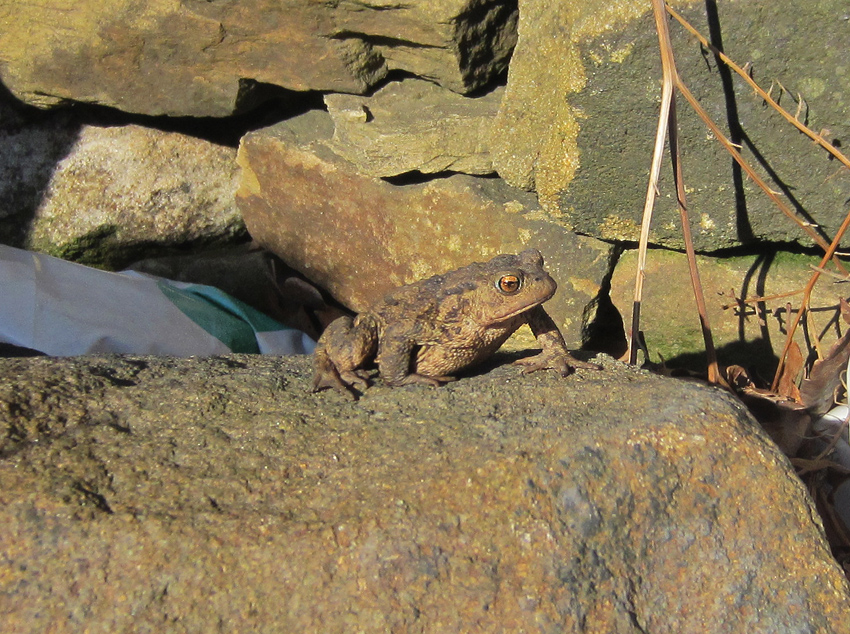
Common Toad, Harden, Bingley, West Yorkshire - Sunday 11th March 2012

The highlights were the random toad found at the start of the event, and the yaffling Green Woodpecker, which eventually flew into view, and a Common Buzzard flying over as we walked back to our cars. The kids and parents found all these things, including these really interesting scratches on the several branches of a Holly tree that had been cut down. I assumed this was the work of a Grey Squirrel - we'd seen these around the wood - but after consulting my trusty copy of Tracks and Signs by Bang and Dahlstrom, I'm not so sure. Any ideas?

The work of a Grey Squirrel?

The kids seemed to enjoy it, and so did the leaders and parents. Don’t believe all that crap you hear about children failing and standards falling: these kids know their stuff, they're eager to learn, and they ask far better questions than adults ever do.

So, basically, I had great day: enjoyable, worthwhile, life-affirming.

Tuesday, 6 March 2012

A twitch too far?

Next Sunday I will be leading a group of Bradford youngsters on a bird and nestbox survey, for the benefit of their education and the wider environment.

There, I feel better now. Knowing that I will be doing something positive next Sunday somehow assuages the guilt I feel for being a rabid tick-hungry twitcher, going on a monstrous journey to (attempt to) glimpse some rare birds last Saturday.

I went to see the first-winter male Common Yellowthroat at Rhiwderin, Gwent, South Wales. For the UK, this is a rare bird – very rare – with only nine previous records. I wasn’t going to miss this. Work, family, daughter’s birthday, and other commitments had slowed me down, but finally I got the opportunity to go – and also got a lovely, unsolicited note from my daughter.


Up at 3am, on site at 7am, great views by 9am. Get in! Only four birders present when we got our first brief views in the rain; but gradually, as more birders arrived and the skies cleared, the bird revealed itself. And what a peach it was.

It was a beautiful bright yellow on the breast, flashing as it flicked around the branches at different angels. The yellow was noticeable on the undertail coverts too, as it flitted along the hedge, sometimes at eye-level but mostly nearer the ground. Despite the bright colour, it was easily able to disappear in the undergrowth for long periods. It had a dark, almost black, mask with a grey supercilium, and dull green upperparts. Occasionally it fed near a Blue Tit and Robin, giving a good indication of its size.

Then it was on to Pagham, West Susseex, for an overwintering Paddyfield Warbler. Another long journey, and this time in vain. The bird didn’t show all day, on account of the wind I suspect, as it was nice and sunny while I was there. I didn’t hang around, many people looked like they’d given up and weren’t looking any more, and I felt a bit of a mug patrolling the path looking into all the reeds on my own for 45 minutes. Stonechat, Curlews and a Spoonbill flying over low were all nice, but not what I’d invested my time away from the family (and all that petrol money) on.

As luck would have it, a Rose-coloured Starling – another lifer for me – was reported at Hordle in nearby Hampshire. So off I went, with the intention of coming back to Pagham if there was some news. I arrived at the cul-de-sac in Hordle to hear the bird had just left the hedge I was stood next to. Sigh. So I spent an hour looking for the bird around the streets, roofs, tress, gardens (respectfully, of course), while most of the other ten or so birders stood next to the same hedge.

I shouldn’t have bothered. I re-joined everyone, and almost immediately the bird flew into the hedge, nearly hitting me on the head as it did. Bizarrely, most of the waiting birders still missed it as it arrived. Anyhow, we all got good views of the scruffy thing as it sang from within the hawthorn. I’d left my scope in the car but a couple of generous chaps (thanks fellas) allowed me to take a couple of photos with my creaky, first-generation iPhone (the one with the rubbish camera).

Rose-coloured Starling - Hordle, Hampshire, 3rd March 2012

 Rose-coloured Starling - Hordle, Hampshire, 3rd March 2012

No news on the Paddyfield Warbler, so I headed home. Via Kent. Bit out of the way, I admit, but there was (still is?) a female Hooded Merganser at Whedsted gravel pits near Tonbridge. This is a species I’d seen twice before in the UK – a perfectly good looking (and acting) female at Saltholme in Cleveland in 2009, and the long-staying showy male at Radipole in Dorset, which I saw on my trip that way in January.

Neither of these in were accepted as being wild by the birding powers-that-be, i.e. the British Bird Rarities Committee (BBRC). So here was another good candidate – worth another punt, I guess.

After getting lost (in the car, then on foot), I stumbled across a friendly local birder who was heading the same way. The bird was on a medium sized lake, diving frequently at the far side. It was a fetching chocolate-brown female with a lovely ginger crest showing nicely in the warm glow of the setting sun. Really glad I made the detour – regardless of whether it was a genuine vagrant or not.

Extremely boring journey home; but at least I got my two ticks, maybe three once the BBRC have done their stuff. Looking forward to next Sunday: WeBS count at Rodley Nature Reserve, followed by the Airedale Otters. All good stuff.

Wednesday, 22 February 2012

Gulls Allowed

Gulls have never been my favourite birds, but I’m starting to like ‘em – mainly because I’m starting to understand them. This is thanks in no small part to Martin Garner (or, as my friend would describe him, “the old man of the gulls”).

On Saturday, I attended one of Martin’s Gull Master Classes at Stubber’s Green boating lake near Walsall. The site is close to a landfill where the gulls feed, and they come to the lake to wash and roost.  It was very windy, very wet, there was hail, and sleet, and just when we didn’t want it, there was bright sunshine - right into our eyes. But, I learnt loads and loads, particularly about juvenile gulls. And, I learnt that I still know next to nothing!

The focus was on the large white-headed gulls – Herring, Caspian, Yellow-legged, Great and Lesser Black-backed, all of which have 4-year-development cycles. We were asked to ignore the 2nd and 3rd-winter birds, and focus in on the juvenile/1st-winter and adult birds. This approached really helped.

Picking out juvenile Herring Gull in flight, from among Great and Lesser-black Backed Gulls instantly became easy. The pale areas of the wings, the tail pattern, the shade of brown in the wings and scapulars, all became recognisable. We also studied the primary wing tips in adults, helping us distinguish between agentatus and argenteus Herring Gull forms, and Caspian and Yellow-legged Gull.

On the deck we picked out a 1st-winter Yellow-legged Gull (see below). Note how the bird has dark wing coverts coverts and tertials, with little pale fringing. Also note the particular patterning on the scapula feathers, making very distinctive when compared to the Herring Gulls present. The birds do not have yellow legs at this stage.

Yellow-legged Gull - Stubber's Green, Walsall, West Midlands, 18th February 2012

The tail, which can’t be seen well here, was also very different. The Yellow-legged has a darker, shorter tail band, with some restricted dark spotting on the white upper-tail coverts. The Herring Gull has a broader, darker tail band, with much barring on the upper-tail coverts.

The clincher was seeing the single, fresh, median covert feather on the Yellow-legged Gull - these birds tend to start their moult early. Being able to ID a young gull with this level of detail was a revelation to me. My confidence is well up now.

We later moved on to Chasewater for the gull roast, finding a 2nd-winter Iceland Gull (pretty obvious that one though), another probable 1st-winter YLG, and a possible immature Caspian Gull.

An excellent introduction to the dark art of gull identification. Now, where’s the nearest landfill to my house?

Wednesday, 25 January 2012

What a week of birds!

Golden Pheasant - Wolferton, Norfolk, Saturday 14th January 2012

Last week, from Saturday 14th to Sunday 22nd January, I spent nine days birding every moment of daylight, and for even some time after dark too. I was on a trip with Lee Evans, Chris Baines, and Mike Warner (thanks for all the driving Mike). I saw 11 birds new to me, and saw plenty of others better than I’d ever seen before; I learnt loads, and had a good laugh.

Our plan was to see every bird species on mainland Britain during the week, wherever they were. There were so many great birds in the south west we didn’t get to Wales, Yorkshire, or Scotland as planned; but that didn’t stop us seeing loads and loads of great birds. We started in Norfolk, and travelled through Suffolk, Essex (a beautiful place away from the towns), Surrey, Berkshire, Hampshire, Cornwall, Devon, Dorset, and ended in Buckinghamshire.

I saw a total 187 species (using BOU taxonomy). Lee managed 193, using the taxonomy of his UK400 Club, and counting heard-only birds (which I didn't on this trip).

We saw too much for me to attempt to describe it all here, but the highlights were: the striking Dark-eyed Junco showing so well in the dramatic setting of a New Forest clearing, our exciting cross-country dash to see a Little Auk in Buckinghamshire before it got too dark, and me finding probably the first Swallow in the UK in 2012.

Lowlights: the painfully brief views of the Spanish Sparrow at Calshot in Hampshire, and the sad demise of the aforementioned Little Auk the morning after we saw it.

Here are some photos I took during the trip, followed by the full list of birds seen (including splits). The eleven marked * at the top of the list were all British lifers for me.

Rough-legged Buzzard - Holkham, Norfolk, Sunday 15th January 2012
 
Egyptian Goose - Broads Information Centre, Ranworth Broad, Norfolk, Monday 16th January 2012

Mediterranean Gull - Great Yarmouth, Norfolk, Monday 16th January 2012
 
Abberton at dawn, Essex, Tuesday 17th January 2012
 
Glossy Ibis - Chapel Amble, Cornwall, Thursday 19th January 2012

Red-breated Goose with Dark-bellied Brent Geese
Exminster Marshes RSPB, Friday 20th January 2012

Long-eared Owl - Exminster Marshes RSPB, Devon, Saturday 21st January 2012

Hooded Merganser - Radipole RSPB, Dorset, Sunday 22nd January 2012

Little Auk - College Lake, Tring, Buckinghamshire, Sunday 22nd January 2012

Red-breasted Goose*
Ross's Goose*
Bufflehead*
Balearic Shearwater*
Western Sandpiper*
Spotted Sandpiper*
Little Auk*
Richard’s Pipit*
Spanish Sparrow*
Arctic Redpoll*
Dark-eyed Junco*
Mute Swan
Bewick’s Swan
Whooper Swan
Taiga Bean Goose
Tundra Bean Goose
Pink-footed Goose
White-fronted Goose
Lesser White-fronted Goose
Ross's Goose* (not on the British List at the time)
Greylag Goose
Canada Goose
Dark-bellied Brent Goose
Pale-bellied Brent Goose
Black Brant
Egyptian Goose
Shelduck
Mandarin Duck
Wigeon
American Wigeon
Gadwall
Teal
Mallard
Pintail
Shoveler
Red-crested Pochard
Pochard
Ring-necked Duck
Ferruginous Duck
Tufted Duck
Lesser Scaup
Eider
Long-tailed Duck
Common Scoter
Surf Scoter
Goldeneye
Smew
Red-breasted Merganser
Goosander
Ruddy Duck
Red-legged Partridge
Grey Partridge
Pheasant
Golden Pheasant
Red-throated Diver
Black-throated Diver
Great Northern Diver
Little Grebe
Great Crested Grebe
Slavonian Grebe
Black-necked Grebe
Fulmar
Gannet
Cormorant
Shag
Bittern
Cattle Egret
Little Egret
Grey Heron
Glossy Ibis
Spoonbill
Red Kite
Marsh Harrier
Hen Harrier
Sparrowhawk
Buzzard
Rough-legged Buzzard
Kestrel
Merlin
Peregrine
Water Rail
Moorhen
Coot
Crane
Oystercatcher
Avocet
Ringed Plover
Golden Plover
Grey Plover
Lapwing
Knot
Sanderling
Purple Sandpiper
Dunlin
Ruff
Snipe
Woodcock
Black-tailed Godwit
Bar-tailed Godwit
Curlew
Common Sandpiper
Green Sandpiper
Spotted Redshank
Greenshank
Redshank
Turnstone
Kittiwake
Black-headed Gull
Little Gull
Mediterranean Gull
Common Gull
Ring-billed Gull
Lesser Black-backed Gull
Herring Gull
Yellow-legged Gull
Caspian Gull
Iceland Gull
Guillemot
Razorbill
Black Guillemot
Puffin
Rock Dove / Feral Pigeon
Stock Dove
Woodpigeon
Collared Dove
Ring-necked Parakeet
Barn Owl
Long-eared Owl
Short-eared Owl
Kingfisher
Green Woodpecker
Great Spotted Woodpecker
Skylark
Shore Lark
Swallow
Meadow Pipit
Rock Pipit
Water Pipit
Grey Wagtail
Pied Wagtail
Waxwing
Dipper
Wren
Dunnock
Robin
Black Redstart
Stonechat
Blackbird
Fieldfare
Song Thrush
Redwing
Mistle Thrush
Blackcap
Yellow-browed Warbler
Common Chiffchaff
Siberian Chiffchaff
Goldcrest
Firecrest
Long-tailed Tit
Blue Tit
Great Tit
Coal Tit
Marsh Tit
Nuthatch
Treecreeper
Great Grey Shrike
Jay
Magpie
Jackdaw
Rook
Carrion Crow
Raven
Starling
House Sparrow
Chaffinch
Brambling
Greenfinch
Goldfinch
Siskin
Linnet
Twite
Lesser Redpoll
Common Crossbill
Bullfinch
Hawfinch
Lapland Bunting
Snow Bunting
Yellowhammer
Cirl Bunting
Reed Bunting
Corn Bunting