Cirl Bunting, Labrador Bay RSPB, Devon - 11th August 2011
The Cirl Bunting is a rare breeding bird in Britain, confined the south west of England: a remnant population in Devon and an introduced population in Cornwall. So, while visiting the area this summer, I couldn’t miss the chance to see these birds, so I joined up with a couple of volunteer RSPB wardens for a tour of the reserve.
Labrador Bay RSPB, Devon - 11th August 2011
Labrador Bay is one of the RSPB’s newest reserves and is managed specifically for the benefit of Cirl Buntings. The area itself is a working farm, criss-crossed by public footpaths; but the RSPB owns land and they sanction all decisions concerning its use, ensuring it is for the good of conservation.
It certainly has some of the most striking scenery as any RSPB reserve, even though my visit was on an overcast morning with heavy rain forecast. We were fortunate with the weather, and with the birds.
We had only walked a hundred metres or so south from the car park before we spotted some likely finch/bunting-like birds across a wheat field. Family parties of Greenfinch and small post-breeding flocks of Linnet were active in the hedges, but flying from these was a smaller, yellow/brown bird. And there high in a solitary hawthorn tree was a male Cirl Bunting, resplendent in full summer plumage.
Cirl Bunting, Labrador Bay RSPB, Devon - 11th August 2011
The plumage is immaculate, with the striking black and yellow head pattern, and the very obvious red-brown coverts and scapulars on the wings. Through the scope I noticed a duller female and an even paler juvenile close by in the same tree.
Before long a second male arrived, calling from a higher branch, forcing the first male to move on. Apparently, the birds have very small territories, often centred on the corner of a field; so several pairs can have territories around the same small cereal field. Although Labrador Bay is a small reserve, there are an estimated 14 breeding pairs here this year.
We toured more of the reserve, going on a circuit that took us down closer to the sea. A single Common Swift and plenty of House Martins were steadily making their way south along the cliffs. Out at sea a couple of Gannets were also moving south, while closer in a Little Egret was going in the opposite direction. We were lucky enough to get on to a Peregrine, high over the cliffs to the north, while another sat on the red cliffs, its dark moustache and yellow talons clearly visible.
Labrador Bay RSPB, Devon - 11th August 2011
Up at the north end of the reserve we saw another male Cirl Bunting, calling on its territory. The birds were once common in much of England, particularly the South and Midlands, but their range has reduced to this tiny stronghold. Unfortunately, Cirl Buntings are very sedentary, so even though they are doing well here and on other parts of the south Devon coast, they need a helping hand to get re-established in other parts of Britain. A reintroduction programme is underway in nearby Cornwall, using young birds from this reserve and elsewhere.
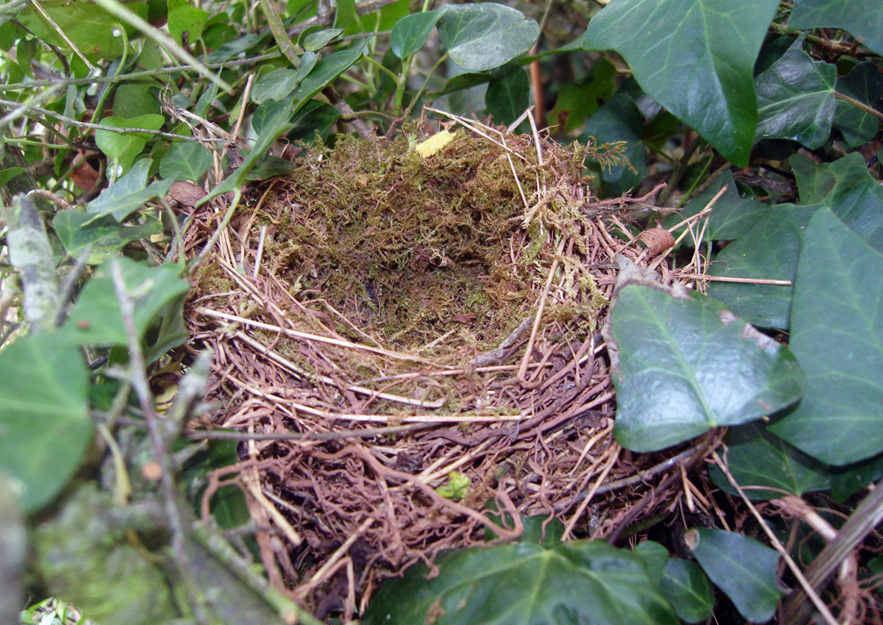
Cirl Bunting nest, Labrador Bay RSPB, Devon - 11th August 2011
The nest was no longer in use - birds from this nest were reared and transported to Cornwall recently. The nest was only just inside a hawthorn hedge, apparently just the way Cirl Buntings like it. By the way, I was given permission to photograph the nest.
My guides finished their work for the day, so I took another hour or so to explore the reserve alone. Before long, in the corner of a wheat field, I found another a pair of Cirl Buntings, this time carrying food - obviously raising a second brood of chicks this year.
Both the male and female brought insects to the nest, particularly grasshoppers that their young prefer - I guess this is the reason Cirl Buntings are more likely to be seen in on the ground in summer than the closely-related Yellowhammers. I watched for a while, getting some photographs and video, but didn’t hang around in case my presence was deterring the adults from feeding their young.
Cirl Bunting, Labrador Bay RSPB, Devon - 11th August 2011
Cirl Bunting, Labrador Bay RSPB, Devon - 11th August 2011
Cirl Buntings, Labrador Bay RSPB, Devon - 11th August 2011
Somewhat frustratingly, the birds showed better in duller light, and then took cover whenever the sun came out. I did manage to get some video of the birds around the reserve.
August is generally a quiet month for birds, so I’d been lucky with my sightings today. As well as the buntings and other birds, we enjoyed views of a Common Buzzard from the reserve’s breeding pair gliding over the fields, and plenty of butterflies (Green-veined White, Meadow Brown, Speckled Wood, and loads of Gatekeepers).
Thanks to the RSPB volunteers who took the time lead the tour and gave me the VIP treatment (as I was the only person on the tour!).
Labrador Bay RSPB is situated 1.5 miles (2.4 km) south of Teignmouth in Devon on the A379 coast road, between Shaldon and Maidencombe. Click here for more information.
I thought I’d missed out on this. For a couple of weeks there have been reports of a fanatsic array of waders at Blacktoft Sands RSPB (near Goole, East Yorkshire). Not in terms of quantity – the big numbers are further down the Humber estuary – but in terms of quality. Several Spotted Redshank among the Common versions; double figures of Green Sandpiper; Curlew Sandpiper; Avocet, dozens of Black-tailed Godwit; and the jewel in the crown: Yorkshire’s sixth Marsh Sandpiper.
But two weeks is not long enough for me to get my act together and travel the hour-and-a-bit it takes to get to the reserve. Work, kids, the Airedale Otters, and the creaky old house we’ve just moved into have all got in the way. But the birds have hung around patiently, and were still there earlier today. And working from home has it’s benefits: I can leave a bit earlier and go birding (and then start again when I get back and end up working until midnight...). There are worse situations in the World at the moment, so I'm not complaining about "being busy".
My journey there was through early rush-hour traffic, and I'd not brought any CDs. In the glove compartment was a CD of a 1959 recording of Tchaikovsky’s Ballet Suites, performed by L'Orchestre de la Suisse Romande, conducted by Ernest Ansermet. A great recording with lots of bass. I think these older recordings sound so much natural than the modern digital ones. I drove back to the excellent Jamie Cullum Jazz Show on Radio 2, featuring an article about Gary Bartz. Great stuff, really fascinating. That was followed by that total chancer Jo Whiley. She has absolutely no critical faculties when it comes to music. But she did play some Sugercubes, so I’ll let her off.
The Marsh Sandpiper had been flushed by an Avocet before I’d arrived, and while combing the reserve for it I saw some of the other great birds here. A lone Curlew Sandpiper was sleeping all the time I watched, but it’s blotchy red breast was easy to pick out. I saw a total of 12 Green Sandpiper, plus there were eight Spotted Redshank form the Marshland Hide. Dunlin, Redshank, Lapwing, Avocet, and Greenshank were the other waders. Marsh Harriers (including close views of a beautiful cream-crowned female), five Little Egret, two Little Grebe, plenty of Common Whitethroat... Plus this little youngster, who simply would not stay still to be photographed.
A shy Common Toad, Blacktoft Sands RSPB, East Yorkshire - 26th July 2011
I eventually found the Marsh Sandpiper from the Ousefleet screen, feeding alone near some active Dunlin and inactive Lapwing. A couple of Redshank helped give a size comparison. The bill is so fine, like a phalarope’s, and the front of the face was almost pure white. The bird’s gait was striking too, being very elegant and long-legged. The feeding technique was obviously to pick food from the surface of the water, rather than probe. I managed a poor record shot…
Marsh Sandpiper, Blacktoft Sands RSPB, East Yorkshire - 26th July 2011
It soon went from view. But by the time I’d walked to the Singleton Hide at the other end of the reserve, it was there, much closer this time and with a Greenshank for comparison. What a lovely, dainty bird.
A while back I promised I’d improve my note taking, and spend less time trying to take bad photos. And here I had a such a good opportunity to compare the Marsh Sandpiper with a Greenshank stood next to it.
Marsh Sandpiper, Blacktoft Sands RSPB, East Yorkshire - 26th July 2011
The difference in bulk really only becomes clear when they're next to each other. The Marshy being more dainty and graceful, with such a fine bill. There was also a suggestion of a crown stripe. The head and neck colouring on the Greenshank wass much darker, covering the whole face and lores and extending further down the breast. The Marshy also had more colour variation in the wing, which had a dark leading edge and some brown in the primaries. The spotting on the uppers was larger on the Marshy; the Greenshank's uppers are more of a uniform speckling. All very educational.
A great afternoon/evening, and a new lifer for me. And I highly recommend Blacktoft, at any time of year.
Recently, a friend of mine told me this story about a hoard of nuts their friend found in a car engine.
My friend’s friend works in a garage in Bradford. Earlier this year a driver brought in an Aston Martin, complaining that the car was performing sluggishly. When the mechanics opened up the hood, they found that the car's air filter was crammed full of peanuts (the kind found in garden bird feeders).
A grey squirrel had been hording its nut supply in the car over winter, no doubt raiding a nearby bird feeder or three and storing the swag in the car’s engine.
It’s the amount of nuts it managed to squirrel away that’s remarkable. I’m not surprised the car was “sluggish”. Obviously someone in Bradford mistakenly thinks their garden birds have a really healthy appetite for nuts. It makes me wonder quite where all the peanuts from our feeder end up. Better check my air filter…
A quick google suggests there are a few similar stories from around the country of squirrels hoarding nuts in cars (see here, here, and here, for examples). And interestingly, most of the stories appear to be from late winter and early spring.
Thanks to Ann and Steve for the story and pictures. And apologies for the headline.
Sunrise over the Duck Marsh, Rodley Nature Reserve, Leeds - Sunday 17th July 2011
A 05:30 start this moth's BTO WeBS count, finishing at 08:45-ish, and just missing the rain. The weather was great to start with, but it darkened as the clouds rolled in.
Rainbow over Rodley Nature Reserve, Leeds - Sunday 17th July 2011
Highlights this month:
A single group of 82 Mallard (there were others scattered around), made up mostly of juvenile birds born this year.
Great views of a Kingfisher from the Reedbed hide (the best place to see these here). The bird looked a little worn – it’s probably been busy tending to young for the last few weeks.
Four Little Grebe adults – no young though after they were predated by Mink.
Lots of young warblers around in the scrub and willow. Chiffchaff, Willow Warbler, Blackcap, Common Whitethroat. We had some ID challenges with two groups of possible young Lesser Whitethroat skulking in the hedgerows (plain grey-brown uppers, mostly pale underparts, dark grey hood with a darker grey eye-mask). Lesser Whitethroat are not common at Rodley, but I heard some had been seen earlier in the month.
A nice array of finches in the trees near the entrance bridge: Bullfinch (including two young), Goldfinch, Chaffinch, and plenty of Greenfinch.
Three Common Tern having an argument over the reserve (a pair are breeding here this year).
One Stock Dove. Nothing particularly interesting about that, but I just like to mention them as they’re one of my favourite birds and they're so often overlooked.
The WeBS counts are generally too early in the morning to see much in the way of butterflies, but other wildlife included two Roe Deer (an adult female and young male), young toads, and a pool in the reed full of tiny young fish. Any help on identifying the fish species would be welcome!
Fish (?!) at Rodley Nature Reserve, Leeds - Sunday 17th July 2011
Yes, I went twitching again the other day. I went to see this beauty…
White-throated Robin - Hartlepool Headland, Cleveland
White-throated Robin - Hartlepool Headland, Cleveland
A 1st-summer female White-throated Robin (Irania gutturalis) at Hartlepool Headland, Cleveland. This is a mega rarity for the UK, and in fact for anywhere in Western Europe – its breeding range stretches from Turkey to Afghanistan, and it winters in eastern Africa. Yep, a mega rarity.
A lucky bird-ringer trapped and ringed the bird on the morning of Monday 6th June 2011, and after a initially thinking it was a Red-flanked Bluetail (a less-rare bird, but rare one nonetheless) he realised he was holding the birding equivalent of gold dust in his hand. There are only two previously accepted records in the British Isles – one on the Isle of Man (an area not covered by the ‘British List’) in 1983, and an untwitchable bird on Skokholm Island in 1990.
The news was released fast and the really (mad) keen twitchers were there by late morning, watching the bird as it fed on a municipal bowling green. Unfortunately, by the time most birders had finished work and got up to Hartlepool, the bird had retired to the garden of the local doctor’s house, no doubt for some peace and quiet. This particular garden was surrounded by a very high wall coated in anti-vandal paint. This wouldn’t stop you average hard-core twitcher though. Oh no. Here’s some footage of the scene from YouTube…
With such a rare bird, and all that craziness going on, the decision for me to go and see it was no-brainer. And see it I did. By the time I arrived most of the fuss had died down, and the good doctor had generously opened his garden to allow viewing of the bird. I had a wonderful couple of hours sat on the flattest lawn ever, enjoying great views of this sprightly, long-tailed beauty. Here’s my own low-grade video of the robin:
Job done a super-rare tick, some banter with good-humoured twitchers and locals, and all with the minimum of fuss. But, why was I feeling so guilty?
The question, “Was it worth it?” was going round my head as I drive my passenger-less car back down the A1. “Of course it was worth it”, I thought – it was cracking bird. And it only stayed for five days and was gone before the weekend, so it was a good job I went when I did! But really, really, was it worth a total of four hours driving, using most of a tank of petrol (and the associated climate-changing effects of burning it), just to get that special tick on my list? Err… yes? Maybe? I don’t know. I did put £5 in the bucket at the doctor’s house, to aid the local bird group, but that hardly balances the £50 I spent on fuel.
If I’m honest - really honest - it’s not the harm I may be doing to the environment that makes me feel remorseful, although that’s bad enough. It’s those few stolen hours away from my family I feel the most guilt about. Just the other day my six-year-old daughter gave me a lovely Fathers’ Day card she’d made at school, complete with a generic poem urging dads everywhere to make the most of those early years, when their kids are young. “You’ll never get those years back” it said, “and you’ll feel really guilty if you spent any of that time twitching or watching football or jetting off to music festivals you selfish, heartless pig”. Okay, I made that last bit up, but you get my point. If the poem was intended to induce pangs of conscience in the dad reading it, it did its job. It reminded me of the time I spent twitching a Great Grey Shrike (a bird I’d seen before, and didn’t need for my list - I just wanted to show it to my friend) on the morning of my daughter’s 3rd birthday party. I got back in good time and everyone was happy, but thanks to that card a strong feeling of guilt has come back some three-and-half years later….
But, I’m not a complete rarity-obsessed monster. Honest. I’ve been doing plenty of non-twitching wildlife things recently, including things with my kids, which I hope redresses the balance in favour of responsible birding. In the past ten days alone I’ve helped with the monthly BTO WeBS count at Rodley Nature Reserve; done my own monthly WeBS survey on my section of the River Aire; written an article for my local bird group’s magazine; launched a new RSPB youth group for my local area; done my final site visit for this year’s Redshank Breeding Survey; taken my children to a local Springwatch event; and spent an evening in the rain listening to Nightjars at a traditional local site.
All that and I still feel guilty about the twitching.
Primavera Sound, held each year at the Parc del Forum, Barcelona, is one of my favourite music festivals, and having missed last year’s event I was determined to go in 2011. Some great bands on this year, although thanks to various issues, I managed to miss many of the ones I wanted to see.
Of course, visiting another country can provide some interesting birding opportunities. Unfortunately, my stay was for the three nights of the festival only. Anyone who’s been to an event like this in Spain will know that things start late and go on well into the morning – so you won’t see much daylight, or be sober enough to focus your bins if you do manage to get out. So, basically, I didn’t get any birding in; but did keep an eye out for ‘em while I was in the city.
The taxi ride from the airport to my friend’s flat, near La Sagrada Familia, took around 40 minutes, with me sitting in the front seat with my binoculars (raised eyebrows from the cabbie). En route to the city, there are some interesting habitats: the flat agricultural land near the airport, the tantalising Llobregat delta reserve, the cliffs of Montjüic near the docks… All for me to explore on my next trip, I hope.
The only birds I saw on the journey that I could ID with confidence were:
Yellow-legged Gull (Larus michahellis Absolutely everywhere in the city, easily separable from ‘our’ Herring Gulls by their yellow legs and darker upper wings – not as dark as ‘our’ Lesser Black-backed Gulls though…);
White Wagtail (Motacilla alba The nominate sub-species M. a. alba, of which the British version is the Pied Wagtail M. a. yarrellii);
European Magpie (Pica pica A nice change to see these, having visited the Scottish Highlands last weekend and seen hardly any - thanks to land owners trapping them);
Common Swift (Apus Apus Over the rooftops in the city in summer);
Blackbird (Turdus merula Heard singing almost as soon as I stepped from the cab).
Hmmm, not a very impressive list, is it? I did catch sight of a slim falcon species over the cliffs across the road from the harbour, but it was too high for me to ID from a moving vehicle. Definitely not one of the reintroduced Peregrines - too slim and thin-winged. It was almost certainly a Kestrel from the large colony at Montjüic.
So, after a beer or two at my friend’s flat, it was straight to the festival. Having spent the last couple of years telling anyone who’d listen that this was one of the best-run fests you could visit, the organisers overstretched themselves this time, leading to total chaos. The innovation this year was a pre-pay system for your beer and food. In theory, you added money electronically to a special festival card thus removing the need to come with anything other than the card and your T-10 Metro ticket. All well and good, if the server can take the weight of all the traffic when people are trying to register for it… So, after lots of queues and grumpiness, late on the first night we were all paying cash for our San Miguels, just like in the olden days.
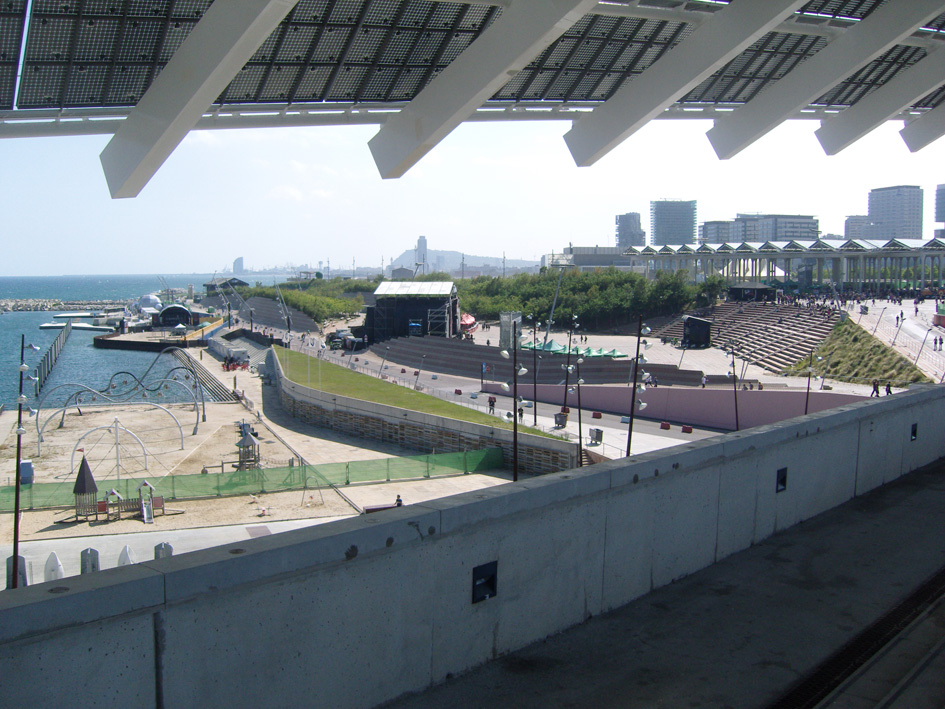
The solar panel - the most obvious landmark at the Parc del Forum, Barcelona
Grinderman were the first band I watched - on paper, a band I really should like, but as yet I’d not been drawn to listen to. Verdict: they made a great noise, and they looked great on stage, but where were the tunes? The Birthday Party and the Bad Seeds never struggled for a tune, but I didn’t hear too many during this set. Oh, and their guitar solos were too short. I guess I should actually listen to one their CDs – I do keep seeing them lying around the house.
Now then, Suicide, bone fide electronic music pioneers - tonight they performed their first album, Suicide, in full. [Note, their second album is also called Suicide. Crazy guys…]. These chaps are old, but don’t think that lessens any of their impact. In fact, depending on who you believe, singer Alan Vega is anywhere between 62 and 108 years old, and his deliberately creepy demeanour still cuts through in his deadpan vocals.
Martin Rev and Alan Vega - Suicide at Primavera, Barcelona, 26th May 2011
Meanwhile, Martin Rev produces simple, sweet Casio chord progressions punctured by atonal stabs of noise, all over a hissing, popping Roland rhythm. The whole vibe is sinister and menacing, yet also poignant and tragic. And slightly odd. Down the front of the amphitheatre, standing on the hot, litter-strewn concrete in front of the pumping speakers, I imagined the atmosphere was similar to their early No Wave gigs in the bankrupt New York of the late 70s. Bizarrely, it was probably my favourite moment of the festival.
After getting lost in the darkness, in a good way, I finally found my way to the main stage to watch The Flaming Lips. My interest in this band has waned (there’s a pun in there somewhere) over the years, after being blown away in the mid 90s by their albums Hit to Death in the Future Head, Transmissions from the Satellite Heart, and Clouds Taste Metallic (all highly recommended). After the departure of guitarist Ronald Jones their sound became a little ‘straight’. But while they lost some sonic experimentalism, they developed a great stage show. I doubt few people could fail to enjoy their lightshow, banter, and antics, with singer Wayne Coyne dressed ridiculously throughout. Their earlier material was a bit thin on the ground tonight, but it was a fun show all the same.
Friday started with the most exciting bird sighting at the festival (well, pretty much the only bird sighting at the festival…), when a White Wagtail few over the bar near the solar panel, where I was stood deciding on the first band to see. Yes, how my priorities soon shift from birding and music, to booze…
I chose to start the night with a punt on The National, a band I’d hitherto ignored. And they were not bad at all, I have to say. They’re from the USA, but seem to be doing all they can to hide this fact. They sound like a grown-up Joy Division, but without all the cheesy conceit of Interpol, and tick all the right boxes by having a brass section and big, big guitar endings. No, not bad at all, although I suspect I’ll never buy one their records.
Then came the biggest fail of the festival, because I listened to my friends and not the little voice in my head. Somehow, inexcusably, I went and watched Belle and Sebastian. Quite why they were so high up the bill, and quite why so many people were watching them (and singing along! And dancing!), I have no idea. I’m guessing it’s the Mumford and Sons effect: It’s really popular, but I know of no one that likes it. I know enough of this band’s music to know it’s dull, flavourless, and weak – like a watery, headless, pint of bitter. Don’t get me wrong, I love bands like Stereolab, Pram, Cocteau Twins, so being twee (or Scottish) is fine by me; it’s being utterly shite that I can’t stand. It’s music that wouldn’t get used on a Lib-Dem party political broadcast. It’s music Radio 2 would reject on the grounds that it wasn’t risqué enough. God, it’s rubbish.
To improve my mood I resolved to go and see Shellac, who were playing at Primavera for the umpteen year running. While making my way to the ATP stage, I noticed Explosions in the Sky were on a nearby stage. I quickly popped over, as I was intrigued how they’d work on a big outdoor festival stage. I’d seen them a couple of times a few years back, and slowly lost interest in the crowded club on each occasion. Here, though, unleashed on a big stage with a massive PA, they sounded immense. I just wish I’d made the effort to get there earlier.
I listen to Shellac records frequently, and see them live occasionally, but here I’m reminded just why Shellac are such a gift to the World. They’re very professional, yet there's something unpredictable about them. They’re so tight and controlled, and maybe in the past have come across as po-faced, but they’re a fun-loving bunch who always throw in some theatrical japes into their shows (they did a cracking slow-motion sequence tonight). And they can write a mean tune. Most of the old faves were aired tonight, but there were plenty of new tracks to suggest a new album is on the way. A compulsory purchase.
I reckon Friday’s headliners Pulp are a good band. Not bad. Not brilliant either. I’ll leave it at that.
Saturday’s birding consisted on picking out a Chaffinch singing in Barcelona city centre, and then watching an endless procession of Yellow-legged Gulls glide lazily over opening act Damo Suzuki. It was a good call of my mate to suggest we get here early to see Damo. It was the perfect accompaniment to a warm, hangover afternoon. He usually uses a local band to back him, and the choice today was Barcelona’s Cuzo. They were okay; he was great. But then, he’s a bloody legend.
Damo Suzuki and Cuzo at Primavera, Barcelona, 28th May 2011
Next, Warpaint were on at the large Llevant stage on the far side of the site. This was definitely the place to be, if you wanted to experience the best atmosphere of the weekend... Yes, the Champions League Final was being shown live on a big screen here after the band. I wanted to see Warpaint anyway, as I love their debut album The Fool.
Warpaint at Primavera, Barcelona, 28th May 2011
Warpaint sounded great, in an ace, lo-fi way – the rough edges of their playing coming through the massive PA loud and clear. There was a problem though… but it wasn’t that they didn’t play my two favourite songs: Set Your Arms Down and Shadows. The problem was the band’s stage persona – all giggles and in-jokes and clothes my wife wouldn’t decorate in (and she was a real, lo-fi pop star, nearly). It felt like we were watching a rehearsal. And this made the band come across as a bit smug. In their defence, I guess they were just happy to be playing such a great, relaxed festival, but it was slightly incongruous.
The band were then upstaged by FC Barcelona winning the CL Final against a poor Manchester United – but, then again, I am biased.
I caught some of PJ Harvey’s set, and wished I’d made an effort to see and hear more. Her voice sounds so lovely; she’s really developed it since those days of Sheila Na Gig and Dress. Ah, takes me back to the time I saw her at the Duchess of York in Leeds on her first tour in 1992…
Well, Swans were playing, and I couldn’t miss them, even if my friend was feeling ill and wanted to go home. Selfish, I know, but I'd come along way for this! They performed a cut down version of the set they did at Supersonic in Birmingham last year – basically tracks from their current album My Father Will Guide Me Up a Rope to the Sky. This time they were going though a bigger PA. I mean, what more do you want?
Michael Gira - Swans at Primavera, Barcelona, 28th May 2011
So, that was Primavera for another year. Lots more good memories to take home. Talking of which... Traveling on the Barcelona Metro every night, I was confronted by an image I hope I'll live to forget. I took a photo, so you can enjoy it too.
I’d gone to hell and back (a car park in a Sheffield backstreet) to get a ticket. On the day of the match, I travelled down early morning by train, arriving at 10:20. Why was I in London nearly five hours before kick-off? So I could do some birding first, of course.
Nothing too extreme - just a quiet walk around Hyde Park without binoculars, to get a bird or two on the year list. My targets are both BOU Category C1 birds - naturalized introduced species that now derive from the resulting self-sustaining populations.
I walked from Hyde Park Corner to the Serpentine, looking and listening all the while. I managed to pick up 22 species before stopping for a break near the bridge across the lake. I looked down onto a small jetty in front of me, and there sleeping on the pontoon was one of the birds I was looking for: Egyptian Goose.
Egyptian Goose - Hyde Park, London
Bright green Ring-necked Parakeets are common in the Greater London area, which has a population of 10,000+ now. This doesn’t mean I can just get of a train in the smoke, look into a tree, and see one. Eventually I did, seeing three flying around after following their calls, but not before seeing another interesting Category C bird: Red-crested Pochard. A male a female on the Round Pond. Apologies for the poor quality photos – I only had my iPhone with me.
Red-crested Pochard - Hyde Park, London
So then, three new birds on the year list (yes, I wonder “why?” too). Then off to Wembley for a few too many drinks before the match with the other City fans (that’s Man City, not Stoke).
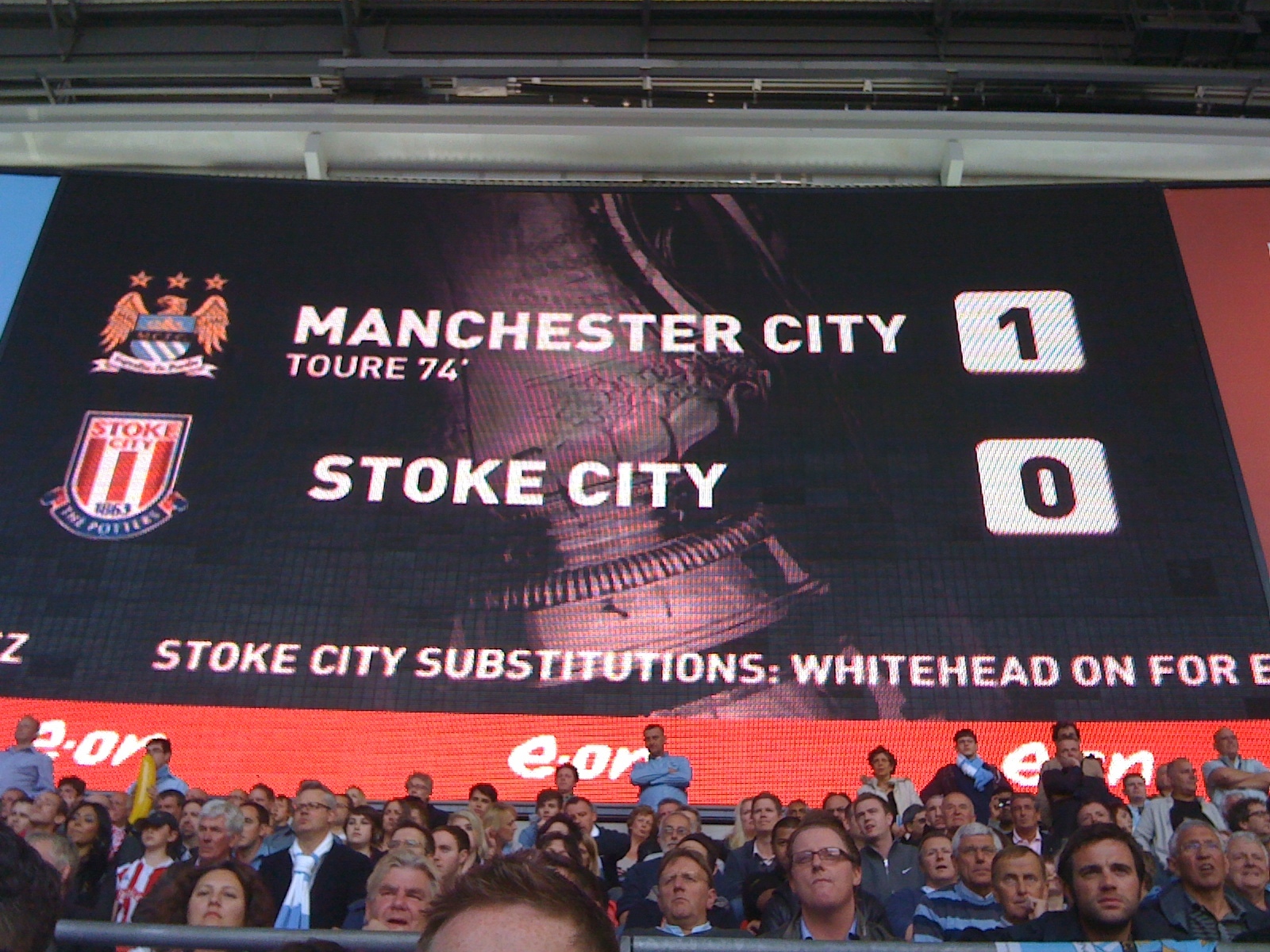
I won’t dwell on the game, there are plenty of proper reports on it. And anyway, I can hardly remember parts of it! But, unlike a famous Man-United-supporting birder (London born and bred, I’d like to point out), I didn’t get bored during the match because we weren’t winning yet and start looking at birds (sorry David, couldn't resist it). So, I may have missed a Peregrine, but rather that than miss Yaya Toure’s goal! The first trophy for 365 years, and the first FA Cup for 42 years (that's since before I was born)!
The final whistle - 14th May 2011, Wembley Stadium, London
Blue moon...
A top day out in the capital – here’s to many more!