Monday, 16 May 2011

Skipwith Common, Bank Island and Wheldrake Ings

A friend of mine, who works for Natural England, invited me to take a day off work to visit these three interesting sites in North and East Yorkshire, between York and Selby. We also had a chat with the warden of Bank Island and Wheldrake (which along with North Duffield Carrs are known collectively as the Lower Derwent Valley NNR, or LDV) and heard about their efforts to catch and radio track Whimbrel and Quail.

Skipwith Common
Skipwith Common is one of the last remaining areas of lowland heath in the North of England, probably because it remained as common, non-enclosed land until 1901. During World War II it was an airfield, which probably protected the heath further. Remnants of its wartime use are obvious everywhere, particularly the former bomb bays, which now are great places to look for basking reptiles.

Bomb Bay - Skipwith Common, North Yorkshire

Unfortunately, the weather was a bit chilly the morning we went (Wednesday 11th May 2011) and the reptiles weren’t showing. We did, however, get great views of a Stoat as it bounded around one of the old brick structures. The other mammals seen were Roe Deer, Grey Squirrel, and Exmoor Pony (used to control scrub growth).
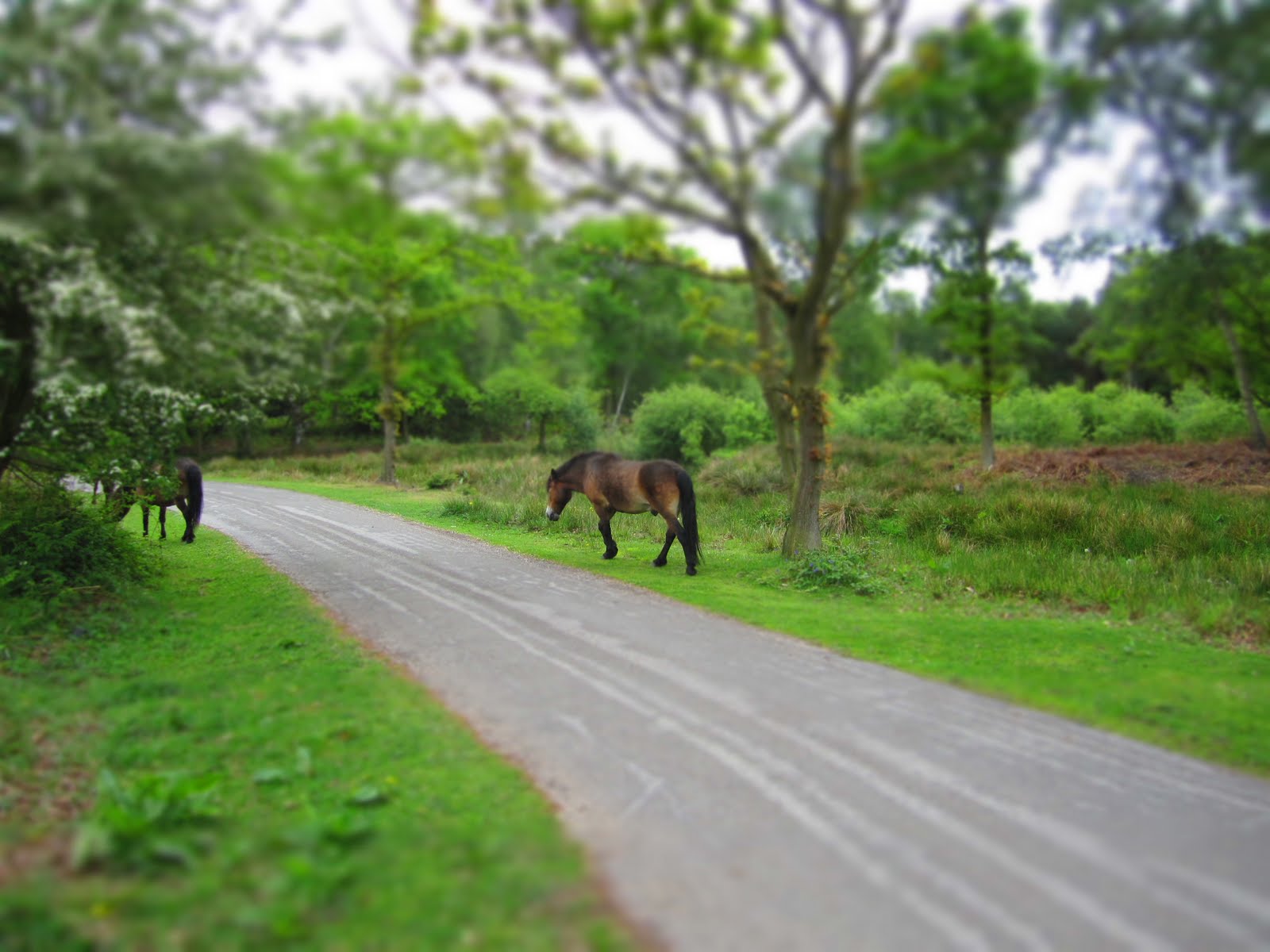
Exmoor Pony - Skipwith Common, North Yorkshire

The trees around the reserve were full of bird song, mainly of common woodland birds, plus warblers such as Common Whitethroat, Willow Warbler and Blackcap. The highlights, though, were the birds of the heathland. We picked out a couple of Tree Pipits from their memorable song, and were treated to great views of a pair of Woodlark on the open heath.

Bank Island
The path to Cheesecake Hide - Bank Island, North Yorkshire

The sun came out when we arrived, and so did the butterflies and damselflies. The brighter weather gave us clearer views into the distance too, allowing us good views of a Greenshank and an elusive Wood Sandpiper on the far pool from the Cheesecake Hide. We met a researcher in the hide studying Lapwing breeding and crow predation – as we watched, Lapwings mobbed a pair of Carrion Crows as they took eggs from a nest (probably a Coot’s).

Wheldrake Ings
We spent the remainder of the day here, a patchwork of hay meadows and pools bordering the River Derwent. The fields are regularly flooded in winter, providing a great wintering area for ducks, and rich grassland for summer visitors.

Unfortunately, the Tower Hide had been vandalised a couple of weeks before our visit, and was still closed; but there is plenty to see from the other four hides on the reserve.

Tower Hide - Wheldrake Ings, North Yorkshire

The trees along the path south from the car park are great fro warbler, and we heard and saw several Garden Warbler, Blackcap, Willow Warbler, Sedge Warbler, Common Whitethroat, and Chiffchaff. We’d had a heads up that Lesser Whitethroat and Grasshopper Warbler could be heard near the wind pump, but we couldn’t pick these up. In fact, it’s difficult to hear anything when that thing’s going round. Having said that, I hope they don’t oil it – it produces a wonderful sound, very mournful.

Wind pump - Wheldrake Ings, North Yorkshire

Near the Riverside Hide we saw two Hobby, catching insects overhead, and we watched a single Common Tern from the Pool Hide. We didn’t hear any Quail – another speciality of this reserve – but it was a little early in the year for these.

Swantail Hide - Wheldrake Ings, North Yorkshire

The Swantail Hide overlooks the lowest (and wettest) part of the reserve. Plenty of waders here - all Redshanks, Lapwings and Curlews on our visit. Four brilliant Yellow Wagtails pinging around us, occasionally resting on fence posts (although none for long enough for me to get a decent digiscoped image).

Monday, 9 May 2011

Otter poo

This evening I went for a walk along the River Aire from Bingley to Saltaire, with the aim of finding Otter poo, otherwise known as spraints.

The otters lay the spraints in highly visible places to clearly mark their territory, often on rocks in the centre of rivers. This helps the spraint-hunter, as they can be easy to spot - if you know what you are looking for. When fresh, the spraints are a slimy dark green, becoming paler and more brown as they dry out. They smell very strongly of fish - and Otter's diet is exclusively fish.  Minks have a more varied diet, so their scat will smell less fishy, and will contain mammal bones and other debris. This was important distinction, as we didn't want to be finding the wrong poo - I've seen Mink along this section of river before.

After a barren first mile, we found a fresh spraint on a rock in the middle of the river. Not easy to access, but with a long stick, we got a sample. Dark green, a similar to goose scat, but without any white. And I can confirm the smell.

Later, nearer Saltaire, we found an older, dryer spraint. Again, not easy to access, but after some clumsy scrambling down the riverbank, I got close enough to take a photo.

Otter spraint - River Aire, Saltaire, West Yorkshire

After mashing it up, the spraint's contents were revealed. Lots of tiny fish bones, although the smell had obviously faded over time.

Contents of the Otter spraint

A successful evening, and now I know what to look out for when walking along the river.

Dovedale, Milldale, Ilam and Stanshope

 River Dove, Dovedale, Derbyshire

I thought I'd share this lovely, leisurely walk, perfect for a Spring day. From Milldale, Derbyshire, down Dovedale, through the grounds of Ilam Hall and up over the hills to Stanshope and back down to Milldale. It took me around five hours, and that included lunch at Ilam Hall and lot of stops for bird-watching.

You can start anywhere along the route, but starting at Milldale means you can look forward to a nice ice cream by the River Dove at the end (and the parking is free), and lunch at Ilam Hall NT is around halfway round.

During the first time I did this walk, at Easter 2007, I encountered the extremes of Peak District weather: chilly, clear skies at the start, warm sun and t-shirt temperatures by halfway, and strong winds and snow by the end. This year, at Easter 2011, it was sun all the way, so be prepared.

 Dovedale, Derbyshire

In Spring there’ll be lots of lambs around, so do heed the notices – particularly if you have dogs with you. Unfortunately, I’ve seen too many people failing to keep their dogs on leads or under control.

 Grazing sheep - Dovedale, Derbyshire

Milldale to Ilam – follow the path south by the River Dove, down Dovedale. There’s plenty to see here, including great views of Dipper on the stones in the river. All the usual woodland species are here. I think I heard a Marsh Tit calling on my last visit, so one to look out for. Also, keep an eye out for Ravens and raptors among the Jackdaws around the rocky outcrops. Plenty of flowers around in Spring, of course.

Forget-Me-Not - Dove Dale, Derbyshire

Lots of butterflies too, depending on the weather and the time of year, including Speckled Wood, Brimstone, Peacock, Small Tortoiseshell, Orange Tip, Red Admiral, Green-veined White, Large White, etc.

Peacock Butterfly - Dovedale, Derbyshire

The southern end of Dovedale gets very crowded, so I’d recommend pasing through here quickly and heading on to Ilam, going vis the footpath over the field north of the Izaak Walton Hotel.

Ilam Hall to Castern Hall – If the weather’s good, I’d eat lunch outside in the Ilam Park, within the grounds of Ilam Hall. The Nation Trust run a cafĂ© here.

There are some good birds along the river here, with Blackcap, Chiffchaff, Willow and Garden Warbler all calling by late April. The trees by the path to the farm and Castern Hall have Common Redstart, so listen out for their call – probably the best way to pick them out once the foliage has grown on the trees.

Lamb - Stanshope, Derbyshire

Castern Hall to Stanshope Hall – Up on to the hills. I saw a Raven being mobbed by Carrion Crows here this year, and it flew very low over our heads. Also keep and eye out for Little Owl and Common Buzzard.

Stanshope to Milldale – Go past the front of Stanhope Hall, taking care to take the right the track to Milldale. By the way, I can recommend Stanhope Hall if you are looking for somewhere to stay in the area.

 Stanshope, Derbyshire

Once you are on the brow of the hill, follow the signs back down to Milldale.

If you go, I hope you enjoy it – let me know what birds you see!

Sunday, 8 May 2011

A Swift Return

The first Swift of the year over our house appeared yesterday, 7th May. As we only moved here in March this year, this was also the first we’d ever had here. Interestingly, despite the unseasonably warm weather we’ve been having, date was later than usual for this area. I had a look in my old journals and found that they usually arrived (or, at least, were spotted by me) in this area early in the first week of May. Here’s the entry from 29th April 2005:

“Jenny and I were changing [our daughter] Rowan’s nappy in her room, and after some bad singing by me, Rowan did her first laugh! The warm sun was low in the sky and shining right into the room. I looked out of the window and caught the briefest of glimpses of two birds flying at speed over the house opposite. These were Swifts, with their familiar thin, semi-circular wings and forked tail, unmistakable, even without hearing their trademark screeching. I opened the window and could hear the buzzing-wheezing of a calling Greenfinch”

Ahh, happy days. I was so moved, I even drew a picture of the scene (including the Swifts overhead and the Greenfinch in the tree):

 Swifts - the view from Rowan's room, 29th April 2005

Anyway, a few birders I’ve spoken to this week have also mentioned the low numbers of House Martin this year. I’ve only seen one myself so far, in Lincolnshire, on the English east coast. I was over there last Sunday, 1st May, twitching a Collard Pratincole at Immingham. I saw Swift, Swallow, House Martin and Sand Martin, all in the same view - for the first time, and what will possibly be the last time, this year.

As well as the fantastic Pratincole, I managed to add another bird to my UK on that trip: the Nightingale. While on holiday in southern Spain last summer, I enjoyed great view of them in the garden of our casa rural; but they’d so far eluded me in the UK. I’d heard that Whisby Nature Park, near Lincoln, was a great place to hear and (with patience) see Nightingales, so I popped down while I was in the area. I heard at least six singing (and oohing, cooing, rattling, whistling, nattering, warbling, and making all kinds of other noises) from the deep within dense brambles and hawthorns. After a couple of brief glimpses of a shy individual, I eventually got a wonderful prolonged view of a showy male belting out his song. Whisbly NP is probably the species’ most northerly stronghold in the UK, and well worth visiting, if only for these wonderful songsters.

My 2011 Year List was improved after a brief trip to Fairburn Ings RSPB yesterday morning. I went with photographer Paul Marfell, hoping to see a Common Crane that was on the reserve. Unfortunately, the Crane was hiding while we were there, but a calling Cuckoo in the Lin Dyke area and very tame Red-legged Partridge from the Pickup hide were the first I’d seen this year.

Red-legged Partridge, Fairburn Ings RSPB (Paul Marfell)

The Lin Dyke area in particular is great for warblers during Spring, with Blackcap, Chiffchaff, Willow and Grasshopper Warbler, and Common and Lesser Whitethroat all calling near the path.

Willow Warbler, Fairburn Ings RSPB (Paul Marfell)

With all these new birds, I've totted up my lists. So, for what it's worth, as of 8th May 2011, they stand at:
- British Life List: 268
- British 2011 Year List: 129
- Garden List: 21 (after only seven weeks at this address)

Wednesday, 4 May 2011

A Royal Disappointment

We all love a Royal Wedding, don’t we? We were all given a day off work so we could sit in front of the TV for hours, coo over dresses and hats, and celebrate all that’s great about Britain (i.e. the Royal Family - a fundamentally undemocratic system of choosing our head of state). Or, thanks to that day off work, we could choose to spend some quality time with our families in the quieter-than-normal countryside.

Unsurprisingly, our family decided on the latter option, with a trip to the Lake District to take a walk, have a picnic, and view the Bassenthwaite Ospreys from Dodd Wood.

Before I go any further, I should say that I have nothing against the couple who were getting married – all the best of luck to them, in fact – but, as my wife pointed out, I wouldn’t have survived more than five minutes watching their wedding, and particularly the build up to their wedding. Listening to hours of mindless drivel from royal correspondents, fashion commentators, and sloany rich kids about “pageantry”, “royal destiny”, and “fascinators”, would make the chip on my shoulder get very, very twitchy. And I reserve particular anti-monarchist ire for the groom’s wildlife-loving brother: best man Prince Harry.

So, on Friday 29th April 2011, we escaped all that and shot off to the Lakes. The weather was great and the journey straightforward, and there was plenty of space at the Dodd Wood car park. We made our way to the upper view-point nice and quickly - apparently 45 minutes in "RSPB-time" (they always assume you walk at a snail’s pace); about 25 minutes in real time. We even got a to see a Red Squirrel just by the path.

So what, exactly, was I disappointed about? Well, it was the Ospreys - or, rather, the view of the Ospreys – that the Royal Society for the Protection of Birds led us to believe we would get. According to their Ospreywatch site, "Our open air viewpoints offer spectacular views of the Ospreys on and flying to and from their nest". We didn’t really get much of a view at all. Instead, we get an incredibly dim and distant view of a nest from the other side of a valley, with a tiny spec – the female’s head – poking out of the top.

The thing is, I’m a birder, and I know that wildlife lives by its own rules, and if a bird doesn’t show, then it doesn’t show – fair enough. But the Ospreys do show – the RSPB has telescopes trained on their nest, so you can see them all the time. But they put the viewing point so far from the nest that even more experienced birders can hardly tell what they’re looking at. Then, they invite us all to see the great spectacle of these birds, and put up massive close-ups of Ospreys on the walk up to the viewing points, getting children and adults alike excited at the prospect of seeing these great birds. When we get there, the view way too distant to satisfy anyone, and certainly not one to inspire kids. We are told we can see the birds hunting over the lake, but again, you’d need some powerful optics, which most casual visitors, and more importantly their kids (i.e. the ones we want to attract to nature) do not have.

It wouldn’t disturb the birds to put the view point closer to the nest – like within a mile of it maybe. They certainly won’t stop determined egg-collectors or other persecutors by putting one so far away. It’ll only put off people making the journey to see these birds, because the dissatisfaction they felt, which was obvious in the expressions of some of the people as they came back down the track.

Now, I really like the RSPB – I’ve been a member for years (including when I was as a child back in the 70s), and I even volunteer for them; so I don’t go along with the minority of po-face and snobbish birders who have a pop at them at every opportunity.

What I'm saying is: don't pin all your hopes (and your children's hopes) on great views of Ospreys from the RSPB's viewpoint. It's a nice walk up there, but you if you really want to see Ospreys, you might want to try a different tactic. On a previous visit we drove across to the layby on the A66, on the other side of Bassenthwaite Lake (still well away from the the nest site). From here you can look east across the lake to view the Opreys hunting, and look west to the high ridge, where we saw an Osprey hanging on the updraft. My two-year-old daughter could pick that one out with little assistance. And I'm sure, with a bit of research, there are other places to get good views from too.

Anyway, I feel bad now - I didn't start writing a blog so I could spend all my time whinging about things. One thing certainly had changed in the four years since our last visit: my daughter’s skill with binoculars...

 Dodd Wood, Cumbria, 29th April 2007

Dodd Wood, Cumbria, 29th April 2011 

And I guess, in the interests of balance, I should also post a picture of my son. Here he is, on his first twitch, at Potteric Carr YWT reserve near Doncaster, watching breeding Black-necked Grebes.

My son, the twitcher - Potteric Carr, South Yorkshire, 5th June 2009

Tuesday, 12 April 2011

Double Buzzard!

Once is lucky, twice looks like a pattern...

I saw a Common Buzzard in Roberts Park, Saltaire, the other day. Not something you see every day in a manicured, suburban, West Yorksire park, but a Buzzard nonetheless. It was a particularly pale individual, but these are variable birds. Its markings and general size and shape all added up to Common Buzzard - broad, pale underwings with dark primary tips, shortish wide tail, cream-coloured underside with brown speckles, darker brown upperparts, right size and shape, etc. I also checked with Salts Estates at the nearby Salts Mill that no falconer had been operating in the area (they have previously used Harris Hawk and Lanner Falcon to control pigeons on the Mill), but they stopped using falconers in 2010.

But today, I saw another one, but half a mile away. I was picking my daughter up from Rainbows (Brownies for under 7s), when a large bulky bird caught my eye, seemingly quartering the park in the distance. I watched it for maybe 30 seconds, then a further 10 seconds from a longer distance. My two-year-old son was running around the busy car park so I was struggling to concentrate, but I did get my bins on it for 10 seconds or so.

The bird was maybe 300 metres away at first, heading slowly west - it came slightly closer. It was over Northcliffe Park when I first saw it and appeared to be hunting. At first I thought it might be a Red Kite, as it had a lazy flapping motion and slightly shaggy appearance, holding it's wings in a shallow V (almost Marsh Harrier-like, though not so pronounced). There ware no marking on the upperwings - they were pretty uniformly dark brown. I ruled out female Sparrowhawk because of the bulk of the bird (it was much bigger than the Jackdaws that eventually came to mob it) and the slow, almost laboured, wing-flapping.

It was a much darker bird than the one I saw last week in Saltaire - a different individual. This bird's underwings had mostly thick dark brown/black edges, white/buff away from the edges. The breast/belly on the Roberts Park bird was the colour of pine furniture (I've just moved house, so I'm in soft-furnishings mode) whereas this guy was more mahogany. The wings were broad and the breast  deep. I saw no barring underwing, under tail, or on the breast.  Not an escaped Harris Hawk, and no Sparrowhawk - too big, dark, shaggy and bulky. No pale rump, tail-base, or flanks.

So, I'm certain it was a Common Buzzard, and a different individual than last week's bird. Believe me, Buzzards are not common round our way. Could a pair have taken up residence somewhere nearby? Seems unlikely, but... I'll keep 'em peeled.

Saturday, 9 April 2011

Learning songs

Earlier this week, at this month's local bird group meeting, I'd been discussing bird songs and calls, and tips on learning them, with my colleague Paul. During a couple of lunchtimes this week, I'd been out birding in local park in the warm weather, and heard a few calls of resident birds and newly-arrived migrants that would be good for a newbie to learn, or for a birder to "get their ear in" in time for the main Spring invasion. So, on Thursday this week we took an hour to wander along the River Aire by Roberts Park in Saltaire.

As ever, the loudest, most bold song was the one that bursts forth from the diminutive Wren. I’m always impressed when the little fella pops up and belts out that busy-yet-controlled call at such high decibels. This was soon followed by the familiar cadence of a Chaffinch. It’s often likened to a fast-bowler’s run-up and delivery in cricket, and having just spent seven weeks watching the beautiful game during the brilliant 2011 Cricket World Cup, I have to agree it’s a great way to remember the rhythm of that call.

The newly arrived Chiffchaff called his name from over the river, in between pecks around the branches and sorties for insects on the wing. At the same moment, an obliging Great Tit did his “teacher teacher” call, to help us eliminate the only vaguely similar call from our Chiffchaff enquiries. Its cousin, the Blue Tit, did its familiar song too. It’s often the first recognisable song of Spring I hear, often starting in early January. It starts with a high “peep”, then goes rapidly down a short scale, and finishes (if he’s allowed) with a short section of relatively lower notes that really characterise the song.

Then, one of my favourites; the true sound of Summer: the Willow Warbler. With a song that sounds like someone coming to the end of a long laugh, it has the vibe of a hot summer’s afternoon that reminds me of the lazy summer days of my youth in the Pennines. We’d cycle up the Woodhead Pass to the reservoirs, and after some pranks and dips in the water, I’d sit and listen to the songs of Meadow Pipits and Willow Warblers and dream of seeing a Common Buzzard (yes, they were rare then!).

I find when learning calls, it helps to see the bird as it sings, to cement the connection. Paul managed a shot of the Willow Warbler in full voice.

Willow Warbler, Saltaire (Paul Marfell)

Robin and Dunnock were the next songs to be separated. I find they have similar voices; but the Dunnock has a repetitive song, as if sung from sheet music, whereas the Robin is more of a jazzer, taking the improv approach. Amongst all these calls and the sounds of Blackbird, Wood Pigeon, Magpie, Mallard - not to mention the rushing weir - we picked out a tuneful almost thrush-like warble. Up At the top of the tallest tree, a large grey-white warbler with a black crown sang as it looked for insects in the buds: a male Blackcap.

Blackcap, Saltaire (Paul Marfell)

So, a steady introduction to the sounds of breeding season, and on the way home from work that evening, I had the pleasure of seeing my first Swallow and Sand Martin of the summer.

But most memorably, at 5pm, straight out of the doors from work, I saw a Common Buzzard flying up out of Roberts Park, mobbed by crows, gulls, and practically everything else. Who’d have thought that possible 30 years ago..?